Warren Buffett Just Bet Big on Real Estate

Today’s Read Time: 20 minutes (totally worth it, we go deep).
This week we’re talkin’ the US economy is hitting the gas, Nashville now has the 2nd lowest unemployment number, the new apartment pipeline is (finally) running dry, and how Warren Buffett is getting deeper into real estate.
Let’s get into it.
Today’s Interest Rate: 6.77%
(☝️ .06% from this time last week, 30-yr mortgage)
The Weekly 3 in News:
US business activity just grew at its fastest pace in over four years. S&P Global’s flash Composite PMI (a monthly survey of purchasing managers) jumped to 56.0 in August, the strongest reading since April 2022, led by a services surge with hiring at its fastest clip since early 2025. (S&P Global, Aug 21)
The Fed heads to the mountains this week. The Jackson Hole symposium runs August 27–29, and new Fed Chair Kevin Warsh delivers his first keynote Friday morning, three weeks before the September interest rate decision. Markets are pricing roughly 33% odds of a September hike. (Yahoo Finance, TechTimes) My take: they will hold rates steady - and as I’ve written before many times - the next real move is more likely a cut, not a hike.
Warren Buffett’s Berkshire Hathaway went shopping for homebuilders.Berkshire’s second-quarter filing showed a 30% increase in its stake in homebuilder Lennar, now about $1.2 billion and 6.2% of the company, a small re-entry into D.R. Horton, and, separately, a completed $6.8 billion acquisition of builder Taylor Morrison. (Fortune, Kiplinger) More on this below.
Titans preseason finale vs. the Chicago Bears — Nissan Stadium, Saturday Aug 29, 5:00 p.m. Last audition before roster cutdowns. (Titans)
Jack Johnson, SURFILMUSIC Tour — Ascend Amphitheater, Tuesday Aug 25, 7:30 p.m. Banana pancakes on the riverfront. (Ticketmaster)
The Piano Men: a tribute to Billy Joel & Elton John — Saturday Aug 29. Note-for-note renditions from some of Nashville’s best session players. (City Winery)
The Economy Just Hit the Gas
The American economy is quietly reaccelerating (and almost nobody is talking about it, for some reason).
Two numbers this week.
First, that flash PMI manufacturing number from the news? At 56.0 it’s the best since April 2022, with services activity at a 20-month high and hiring at its fastest pace since early 2025 (S&P Global).
Second, the Atlanta Fed’s GDP Now model (a real-time GDP estimate built from incoming data, not a survey) currently pegs third-quarter growth at 4.0% (Atlanta Fed, Aug 18). For context, Q2 came in at just 1.5% (BEA). So if the Fed’s model holds anywhere near 4%, that would be a meaningful acceleration.
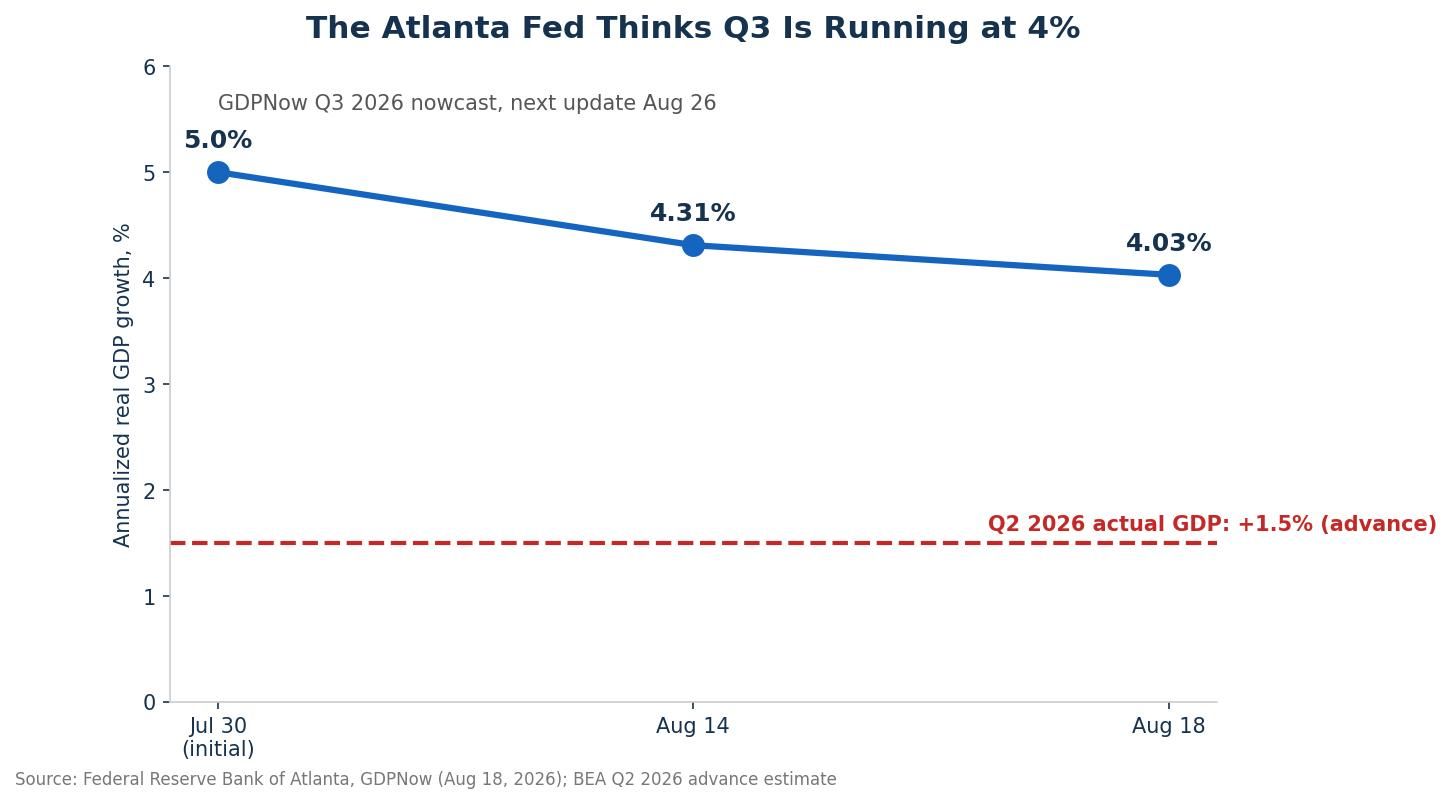
Remember all those recession calls in the spring from the talking heads on TV?
Despite all the crazy stuff happening in the world, the economy remains robust and the doomers keep losing. Careful of those who cry wolf.
What’s Driving It: Chips, Concrete, and Hard Hats
The engine behind the reacceleration is the AI compute buildout: data centers, the power plants feeding them, and the semiconductors inside them.
Harvard economist Jason Furman ran the numbers: investment in information-processing equipment and software is roughly 4% of GDP, yet it accounted for 92% of GDP growth in the first half of 2025. Strip it out and the rest of the economy grew just 0.1% annualized (Furman, Fortune).
That was a year ago; the buildout has only gotten bigger. Private data-center construction spending is now running around $50 billion a year, reportedly more than public spending on transportation infrastructure (NetChoice).
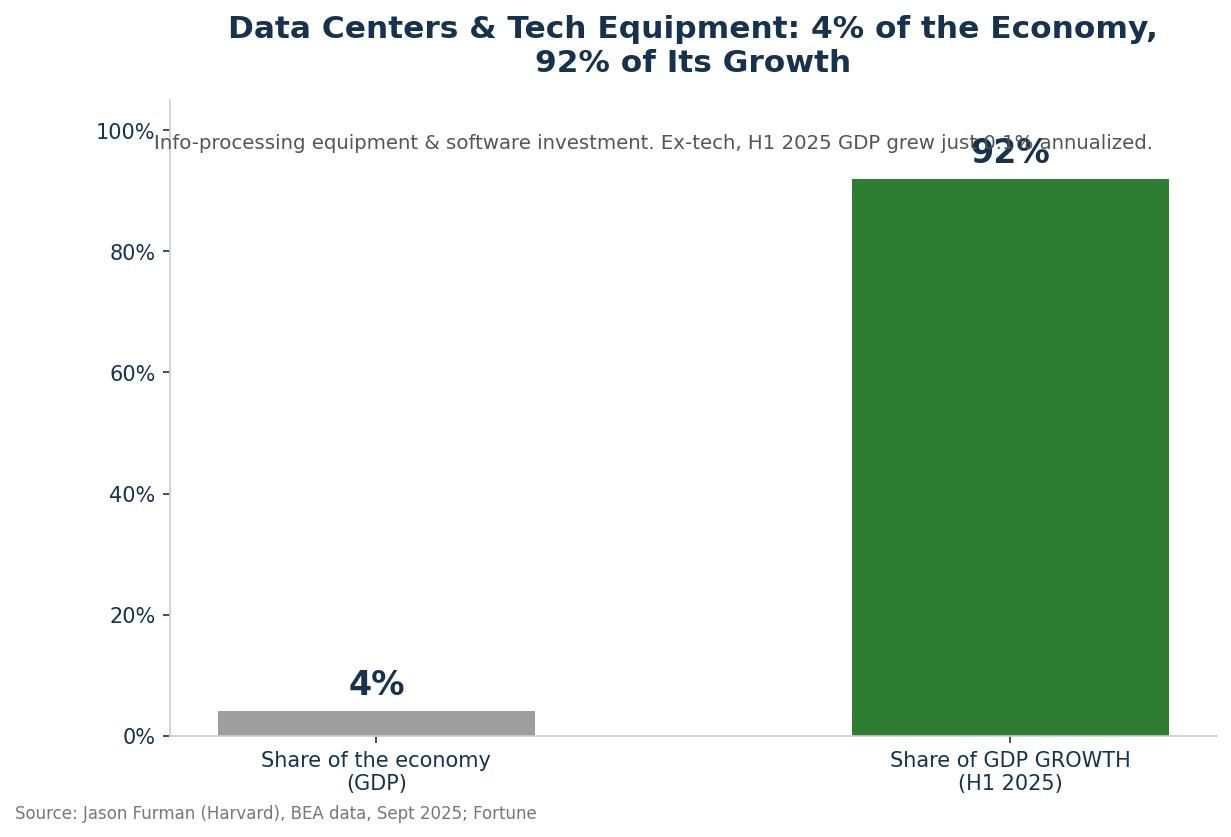
Source: Jason Furman (Harvard), BEA data; Fortune
Unions Enter the Debate
Fun fact, the loudest new advocates for data-center construction are now…. labor unions.
Yep, North America’s Building Trades Unions, one of the AFL-CIO’s largest members and representing roughly 3 million construction workers, has struck national partnerships with Meta, OpenAI, and Microsoft to build AI infrastructure with union electricians, pipefitters, ironworkers, and operating engineers (Spectrum News, Newsweek). Union training centers are expanding and apprenticeship ranks appear to be growing faster than many union leaders have ever seen.
Think about that for a second: the technology certain folks fear will kill jobs, is currently the biggest jobs program in American construction. This is a narrative violation for many of the political factions. I made a version of this argument back in June: AI is not a job killer, and blue-collar trades may be the biggest winners. Two months later, the hard-hats agree.
For real estate investors this matters twice over. Every data-center campus is a payroll: thousands of construction workers for 2-3 years (transient renters, furnished and mid-term rentals), then permanent operations staff (long-term renters, then buyers). I went deep on this in my data-center issue last week. Payrolls = rent checks.
Key Takeaway: the economy is speeding up, powered by a construction boom that hires the same trades that build apartments and houses. Demand is not the problem.
The Steelman: Maybe the Boom Is Narrower Than It Looks
The honest counterargument is hiding inside Furman’s own stat.
If 4% of the economy is generating 92% of the growth, does that mean the other 96% of the economy is barely growing?
Kinda, yeah.
A boom that is narrow, is fragile.
If hyperscaler capital spending pauses (Microsoft and Meta can change their minds fast), the headline number could deflate quickly. July’s jobs report showed the economy shedding 23,000 jobs, and the national unemployment rate sits at 4.1% (BLS), which does not scream 4% growth. The bond market spent last week selling off, dragging the S&P 500 to a weekly loss (Yahoo Finance): long rates rising on fiscal worry, not growth optimism, is the less-friendly read. And GDPNow’s early-quarter estimates are data-thin and volatile.
But the most significant threat to the AI-driven economic and job growth is: government overregulation.
Politicos must be careful when introducing data center moratoriums etc….
The Take Away: the acceleration appears real, and concentrated. If you’re underwriting real estate deals, underwrite the strength of the economy and unemployment numbers in your market, not the national forecast. Watch out for the November elections. The rhetoric fueling campaigns, may be consequential.
The Apartment Machine Is Quietly Sputtering. Good.
Finally, some real breathing room for apartment operators.
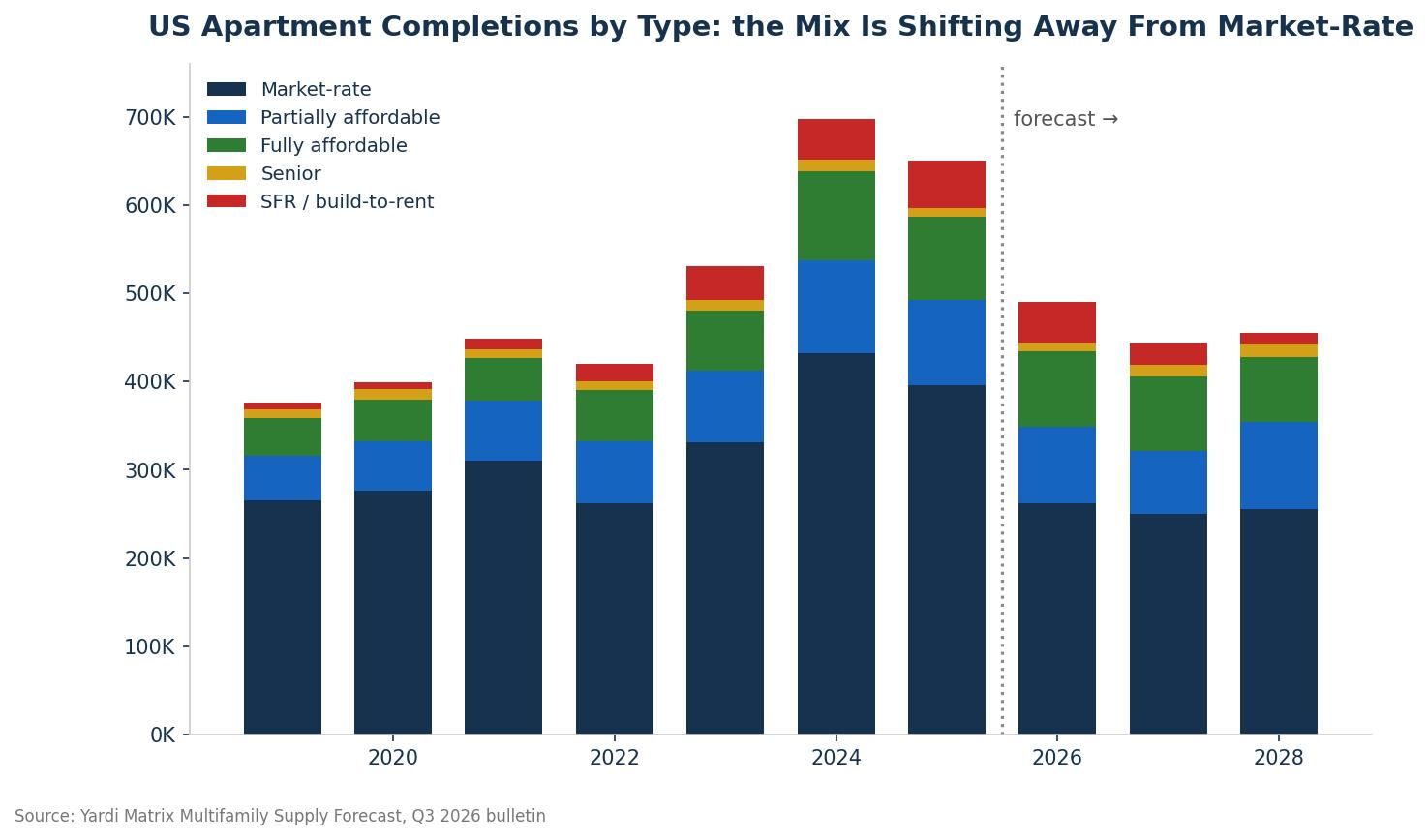
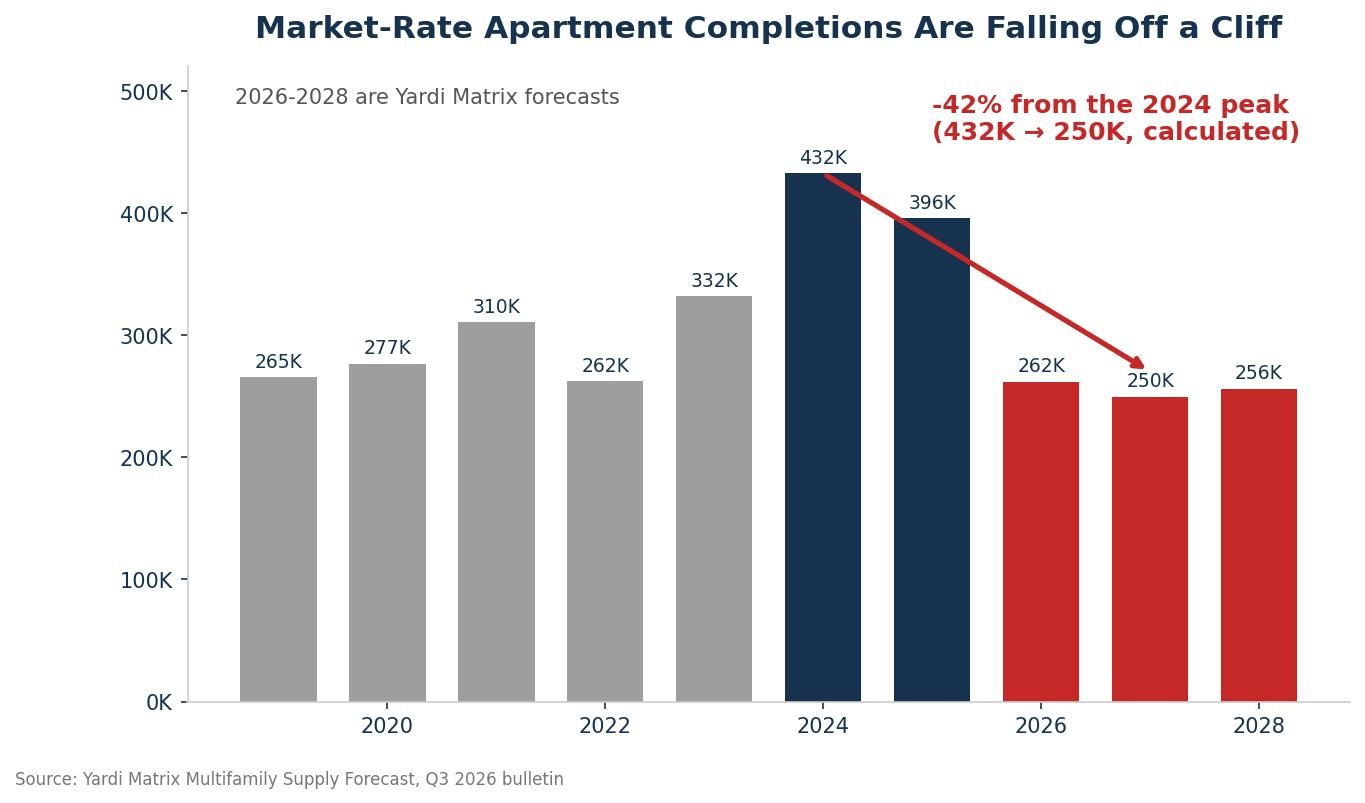
Yardi Matrix’s new supply forecast landed this month, and buried in its tables is the most investor-relevant number I’ve seen all summer: 249,561. That’s how many market-rate apartments Yardi expects the entire United States to complete in 2027, down from 432,215 in 2024. A 42% collapse (calculated from Yardi’s table) in the type of apartment most of us own, operate, or compete against (Yardi Matrix, Q3 2026 Supply Forecast).
The headline forecast says total new supply bottoms in 2027 around 444,000 units, down from 697,000 in 2024. Sounds like a normal cycle. But the composition tells the real story, and almost every industry summary is missing it.
Source: Yardi Matrix Multifamily Supply Forecast, Q3 2026 bulletin
1)) The Market-Rate Apartment Is Disappearing
Total supply in 2027 will actually be about 10% higher than 2020. But market-rate supply will be 11% lower than 2020, down nearly 27,000 units. The entire increase comes from government subsidized product: partially affordable deliveries (buildings where 5-89% of units are income-restricted) will run 22% above 2020 levels, and fully affordable deliveries 44% above (all per Yardi’s bulletin; note their stated percentages, my recomputation from their own table suggests the affordable increases may be even larger).
Translation for operators: the only new apartment builds that still pencil at today’s rates and construction costs increasingly need a tax credit attached. Or are in the A Class bracket.
Building unsubsidized B-Class developments, the kind that competes directly with your Class B/C units on rent, appears to no longer work at current numbers. That is a quiet confession about building and regulatory costs. When paired with higher interest rates of today, developers just can’t make money.
I made the labor-cost half of this argument in Eggs Are Cheap Again. Electricians, Not So Much.: it now takes 349,000 missing construction workers’ worth of wages to build anything.
Source: Yardi Matrix Multifamily Supply Forecast, Q3 2026 bulletin
2)) The Pipeline Behind the Pipeline Is Draining
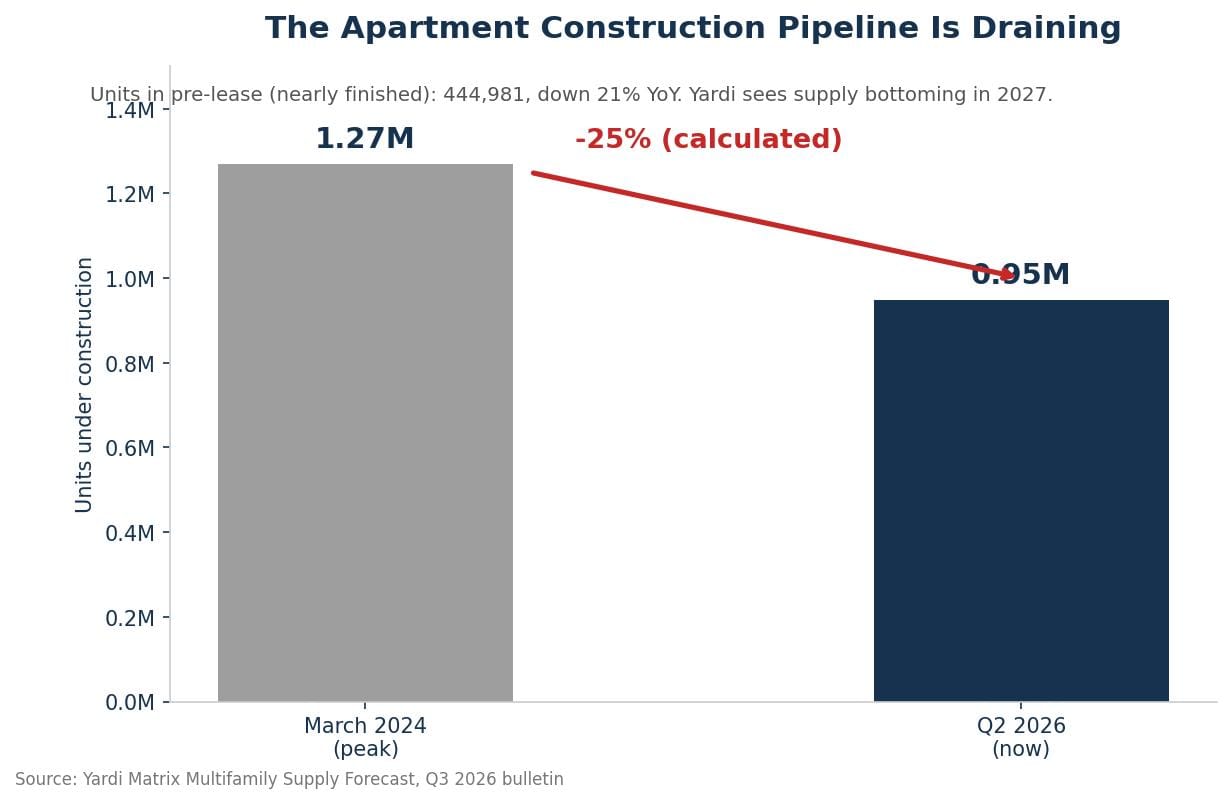
The under-construction pipeline peaked at 1.27 million units in March 2024. It ended Q2 2026 at 948,195, down 25% (calculated). More telling: units under construction and in pre-lease (the ones nearly finished) are down 21% year-over-year. The apartments that will deliver over the next 12 months are already largely spoken for (Yardi Matrix).
Source: Yardi Matrix Multifamily Supply Forecast, Q3 2026 bulletin
One wrinkle: 2026 construction starts are running about 20% ahead of last year’s pace, which is why Yardi nudged its 2028 forecast up. A building rebound may be coming; it’s just modest, and it lands in 2028, not next quarter. And 21 markets (Southwest Florida, Asheville, Miami, Charlotte, Salt Lake City among them) still have over 8% of their existing stock under construction; those markets eat another 18 months of supply pain. Know where your market is what is under construction. In my home market of Nashville, new development has fallen off a very high cliff. (Good for investors).
3)) Rents Have Already Bottomed
While the pipeline drains, demand keeps chewing through what’s left.
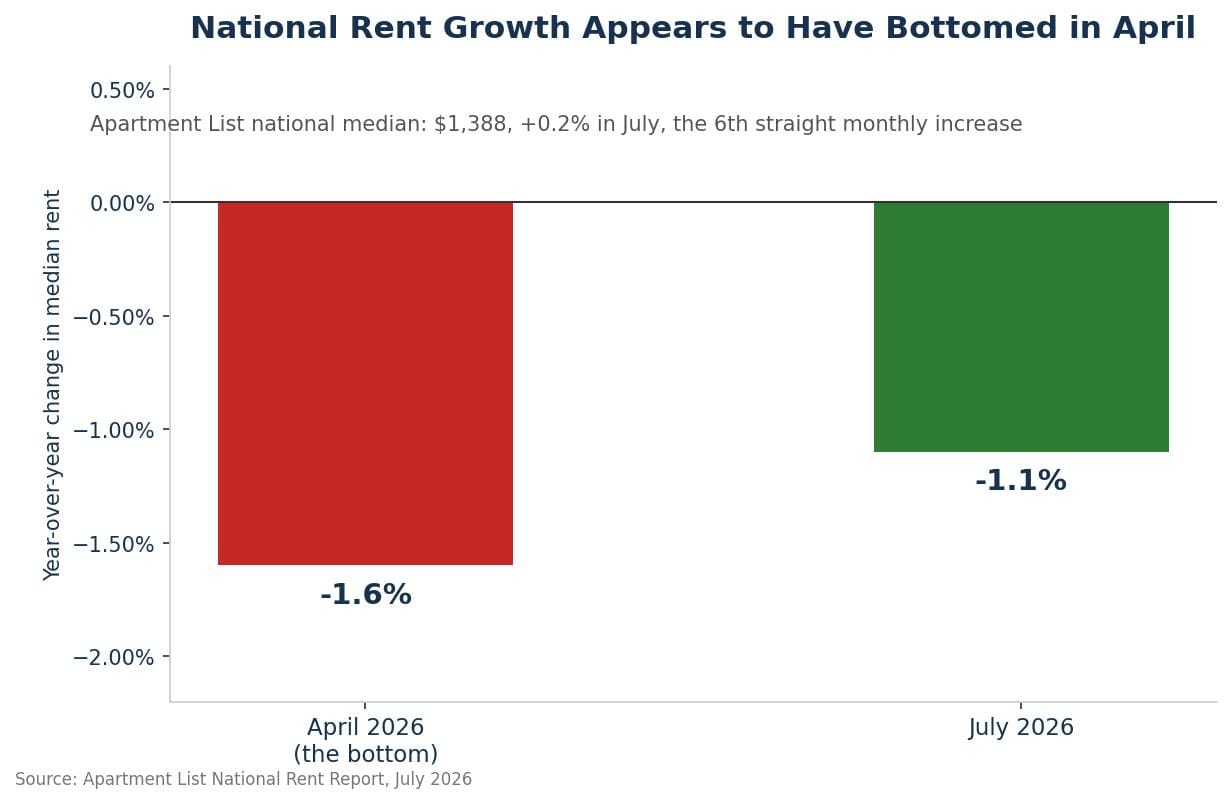
Apartment List’s national median rent rose 0.2% in July, the sixth consecutive monthly increase, and the year-over-year decline has narrowed from -1.6% in April to -1.1% (Apartment List).
RealPage’s second-quarter data showed occupancy at 95.5% with deliveries falling below the decade average for the first time in three years (RealPage).
Rental housing economist Jay Parsons reports first-half absorption came in hotter than expected, producing the best occupancy improvement since 2021, and says he’d “take the over” on the roughly 2% consensus rent-growth forecast (Multifamily Dive).
Source: Apartment List National Rent Report, July 2026
Remember my NBA Jam rule: one data point is noise, two is worth watching, three means something. Six consecutive monthly rent increases is a trend. Last month I told you the apartment glut was going keto. We are now losing the weight.
4)) Real Estate is Reaccelerating, Omaha Agrees
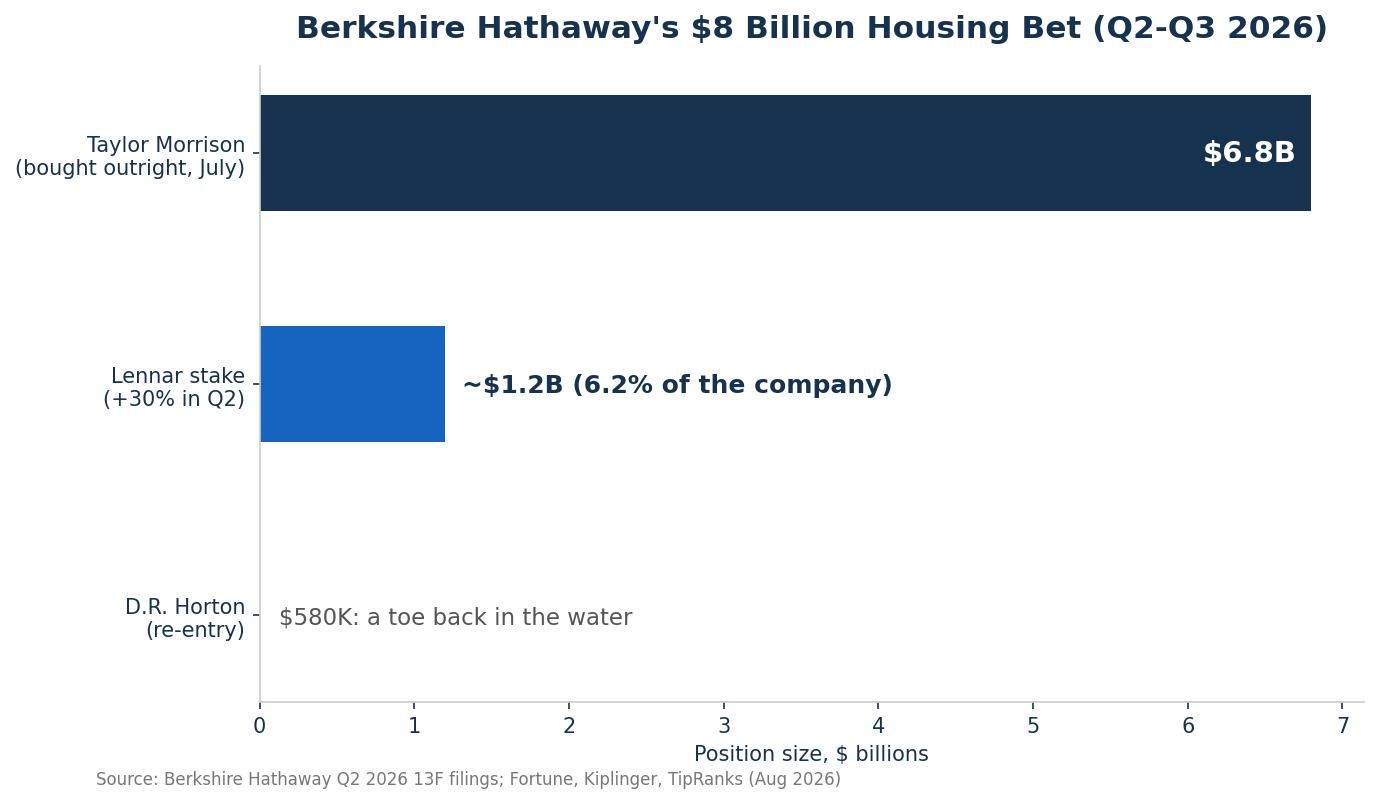
Which brings us to the most famous capital allocator alive. In the second quarter, Berkshire Hathaway increased its Lennar stake by roughly 30% to about $1.2 billion, 6.2% of the company (Fortune, SEC 13G), put a small toe back into D.R. Horton (Kiplinger), and completed a $6.8 billion acquisition of Taylor Morrison, taking an entire homebuilder private (24/7 Wall St.).
Source: Berkshire Hathaway Q2 2026 13F filings; Fortune, Kiplinger, TipRanks
The timing is significant.
Single-family starts just hit a roughly 3.5-year low, homebuilder sentiment has been below 40 for 16 straight months (NAHB), and existing-home sales remain stuck near a 4.06 million annual pace (NAR), the frozen market I broke down three weeks ago. Berkshire is buying builders precisely when the industry is building the least. That is not a bet on today’s housing market. It’s a bet on what happens to prices / rents when years of under-building meet an economy adding payrolls at data-center campuses across the country.
The capital-allocation playbook here, buying productive assets when the industry that makes them is in retreat, is the oldest one in the book. Be greedy when others are fearful (And If you want the definitive study of how eight CEOs, including Buffett, did exactly this across cycles, William Thorndike’s “The Outsiders” is the best thing written on it.)
My Take: connect the three charts. Demand side: a reaccelerating economy hiring construction workers by the tens of thousands. Supply side: market-rate apartment completions down 42% by 2027, the pipeline down 25% from peak, and rents already turning. When demand accelerates into a supply vacuum, the pricing power goes to whoever already owns the asset. This is when the five engines of real estate wealth, cash flow, appreciation, loan paydown, tax benefits, and leverage, start pulling in the same direction (I wrote a whole book on those five, if you want the full framework).
You don’t need to time the bottom. You just need to own before it’s obvious.
The Steelman: Why the Supply Vacuum Might Disappoint
But you never truly know so, here are three counterpoints knocking around in my brain.
First, the affordable-supply wave is not nothing: 156,000-172,000 subsidized units a year still deliver (calculated from Yardi’s forecast rows), and at the margin they compete for the same renters as older Class B/C stock, especially in soft Sun Belt submarkets. “Market-rate supply is collapsing” is not the same as “no new competition.”
Second, Yardi’s own forecast assumes elevated rates persist, which is exactly what suppresses new starts. If I’m right that rates come down toward a 5.5% mortgage (my long-standing view), development math improves, starts rebound sooner, and the vacuum partially refills itself. You can’t have both maximum rent growth and maximum rate relief; the honest version of my thesis accepts a middle path. Note 2026 starts are already up ~20% year-to-date; developers may be front-running the recovery.
Third, on Berkshire: 13F-reading is a dangerous sport. The D.R. Horton position is $580,504, effectively a rounding error, likely an analyst’s tracking position, not an Omaha conviction call. The Lennar stake plus Taylor Morrison is real money, roughly $8 billion, but Berkshire holds about $340 billion in cash-like assets; this is a measured lean, not a table-pound. And one respected outlet spent last week asking whether Berkshire misjudged housing, again, noting new homes now sit about 9.3 months on the market (24/7 Wall St., Dallas Express). Early and wrong look identical for a while. I think the supply math wins eventually, but “eventually” can test your patience and your debt service.
Nashville Is Hiring!
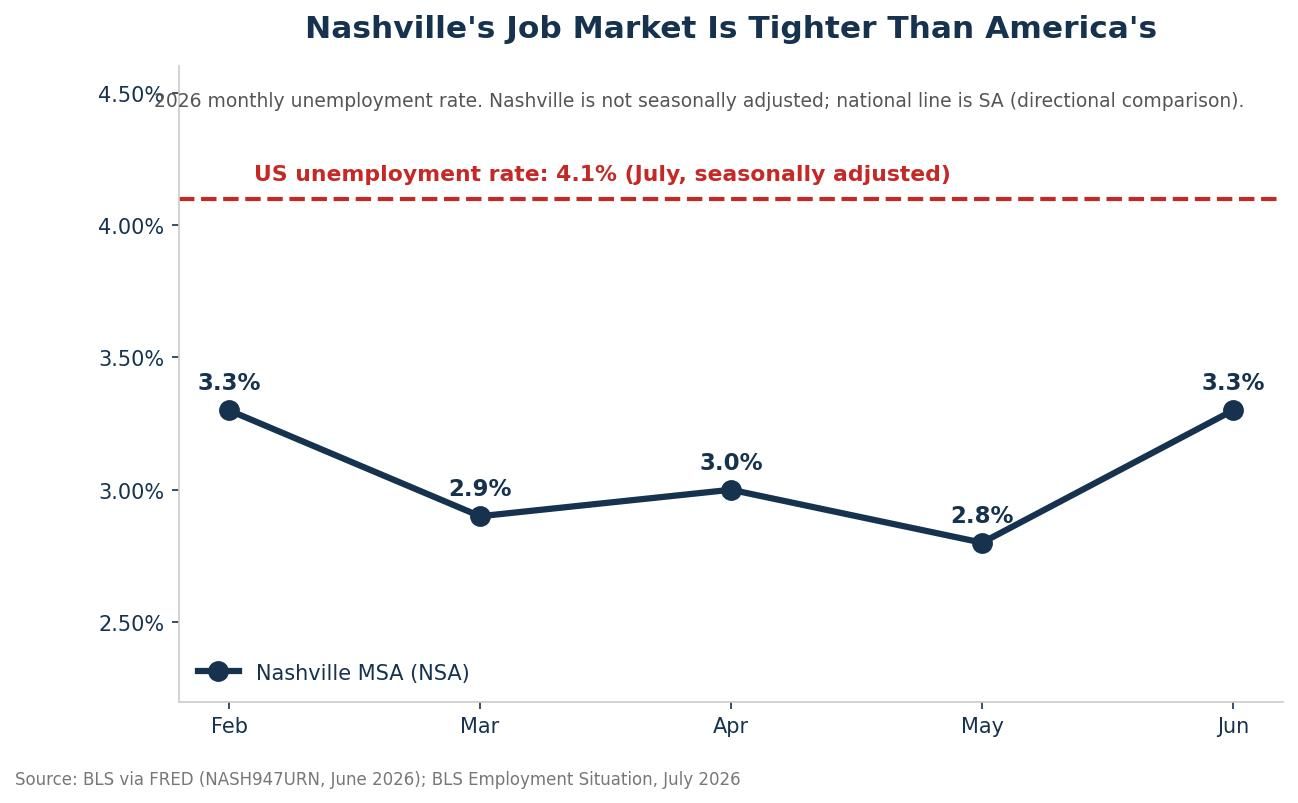
Nashville’s unemployment rate was 3.3% in June. The national rate is 4.1% (BLS via FRED, BLS). In May it was 2.8%, the 2nd lowest of any of the 25 major US cities. And Tennessee overall just posted 3.4% for July, well below the national average (TN Dept. of Labor).
Source: BLS via FRED (NASH947URN); BLS Employment Situation, July 2026
I never get tired of this statistic, and here’s why you shouldn’t either: unemployment is the single most important number in residential real estate. People with jobs are happy and happy residents pay rent on time. People with jobs qualify for mortgages. People with jobs move here from metros that don’t have jobs for them. Capital Analytics just ranked Nashville the #2 metro in the country (behind only Raleigh) across seven measures including unemployment, labor-force growth, and per-capita income (Capital Analytics).
If the US economy is reaccelerating on the back of construction-heavy investment, a metro that starts with sub-3.5% unemployment, in a state chasing a large share of the country’s data-center construction, appears positioned to feel it first and hardest. Tight labor plus population inflows plus the national supply slowdown you just read about: that’s the whole Nashville investment case in one sentence. It’s the same engine I profiled in the $6.6 billion East Bank bet.
One caveat, because we’re narative/conventional thinking skeptics: June’s 3.3% ticked up from May’s 2.8% (these are not-seasonally-adjusted numbers, and summer always adds noise). One month is noise, two is worth watching. If Nashville prints above 3.5% for a few consecutive months, I’ll let you know.
Until then, this remains the tightest big-metro labor market story in the Sun Belt.
My Skeptical Take
The financial commentary this week will be about Jackson Hole: what Warsh says, what he doesn’t, how many basis points hide between his sentences.
Fine. Watch it. I will. (I think 99% chance they hold interest rates steady.)
But while everyone stares at the podium, the physical economy is telling a bigger story: union apprentices are pouring into training centers to build data centers.
The Atlanta Fed’s model reads 4% growth. And the machine that builds America’s apartments is throttling down to levels that, for market-rate product, we haven’t seen in a decade. None of this is a secret; all of it is sitting in public tables at Yardi, the BLS, and the Atlanta Fed. It’s just not on the front page, because supply stories move slowly and slow stories don’t sell ads.
Here’s the thing about slow stories: they’re the ones you can actually invest in. Nobody gets an edge on the Fed statement; forty thousand terminals read it in the same millisecond. The edge is in the boring arithmetic of 2027 completions, compounding quietly while attention sits elsewhere. The renter demand is forming now, on payrolls being hired now, while the buildings that would house them in 2027 and 2028 are, increasingly, not being started. Prices respond to that gap with a lag, and the investors who position before the lag closes are the ones who look lucky in three years.
As the great Wayne Gretzky put it in his famous quote:
❝“I skate to where the puck is going to be, not where it has been.”
The puck is headed toward a supply gap. Buffett appears to be making a B-Line right to it. The builders will follow eventually; they always do. The question is whether you’ll already be standing there when everyone arrives.
Me? I’m looking for my next deal, and I’m going twice as big as my last. So if YOU have a multifamily deal in the greater Nashville or Knoxville area, email me. Let’s collaborate.
Until next time. Stay Curious. Stay Skeptical.
Herzliche Grüße,