Skeptical Investor Alert: Inflation Is At The Fed's 2% Target

Welcome to the Skeptical Investor Newsletter. A frank, hopefully insightful, dive into real estate and financial markets. From one real estate investor to another.
Today’s Interest Rate: 6.19%
This week, we’re talkin’ inflation, inflation, inflation. And why we are likely already be at the Fed’s 2% target.
Let’s get into it.
The Weekly 3 in News:
“[The consumer spending is still growing, the credit quality of the American is strong, and the U.S. economy looks positioned for solid growth in 2026]” - Bank of America CEO Brian Moynihan (CNBC).
U.S. economy grows by 4.3% in 3rd quarter, much more than expected (CNBC/BEA).
Pending home sales in November jumped by 3.3% from the prior month and 2.6% YoY (NAR).
Inflation: Objects in the Mirror May be Closer than they Appear…
We finally got an “official” inflation reading from the Bureau of Labor Statistics (BLS), and admittedly, it was quite positive:
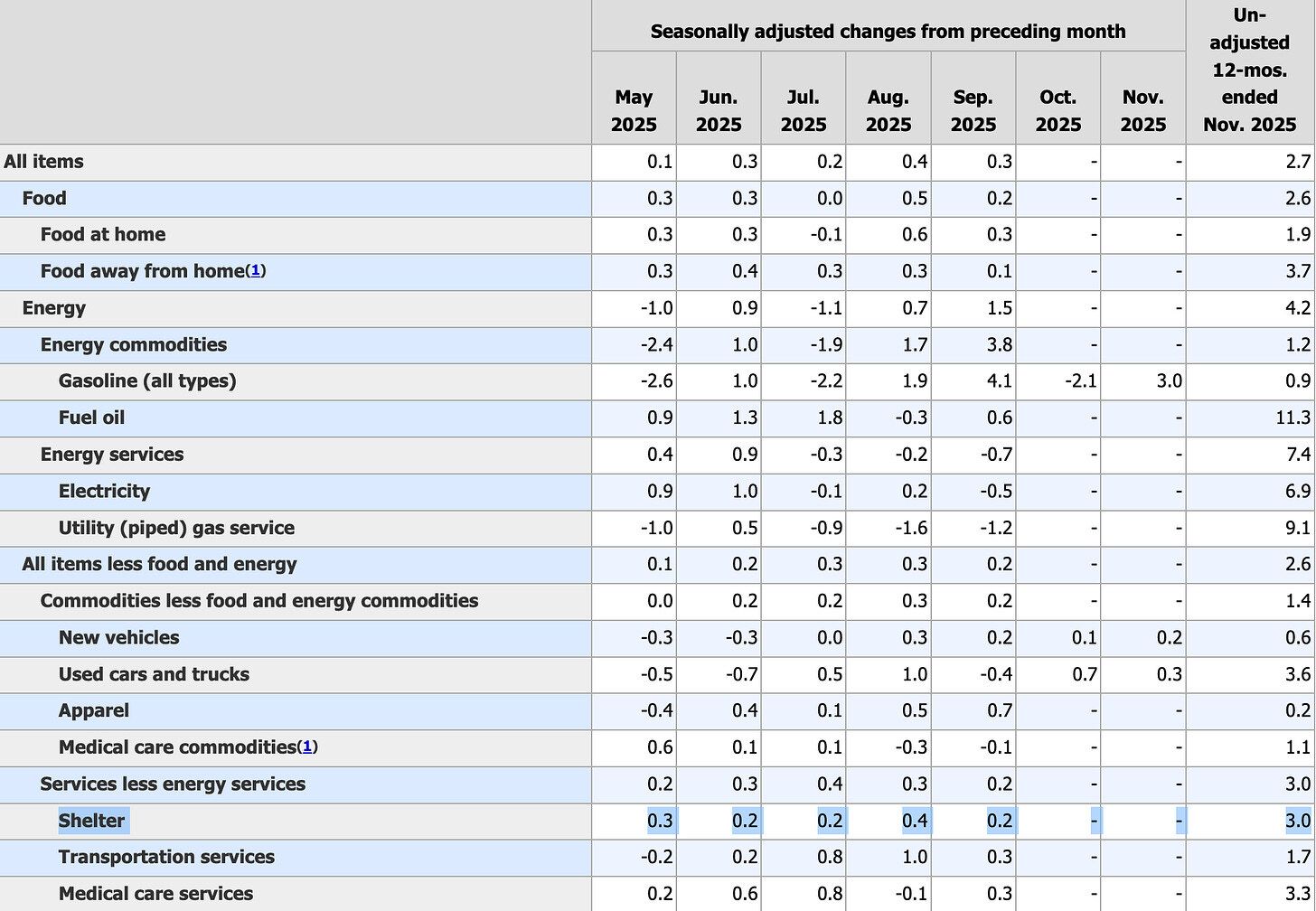
The consumer price index (CPI) came in at .2%, or 2.6% annually, an unexpected deceleration for November after hitting 3% in September.
It was the first CPI report from the BLS since the October government shutdown. So for October, we don’t have any data to compare.
Warning Label: The inflation numbers should be interpreted with caution due to spotty data collection during the shutdown.
However, inflation data does show a cooling off again, after months of gradually increasing.
Nevertheless, count me skeptical.
And it’s not because of the spotty data during the shutdown.
It’s that the largest weighted number, shelter, is complete bull$hit.
What’s Wrong with the BLS Shelter Number?
Now, even IF you believe the shelter number of ~3%, it would be a 2020 and 2013 low.
This would be positive. So why are my gears grinding?
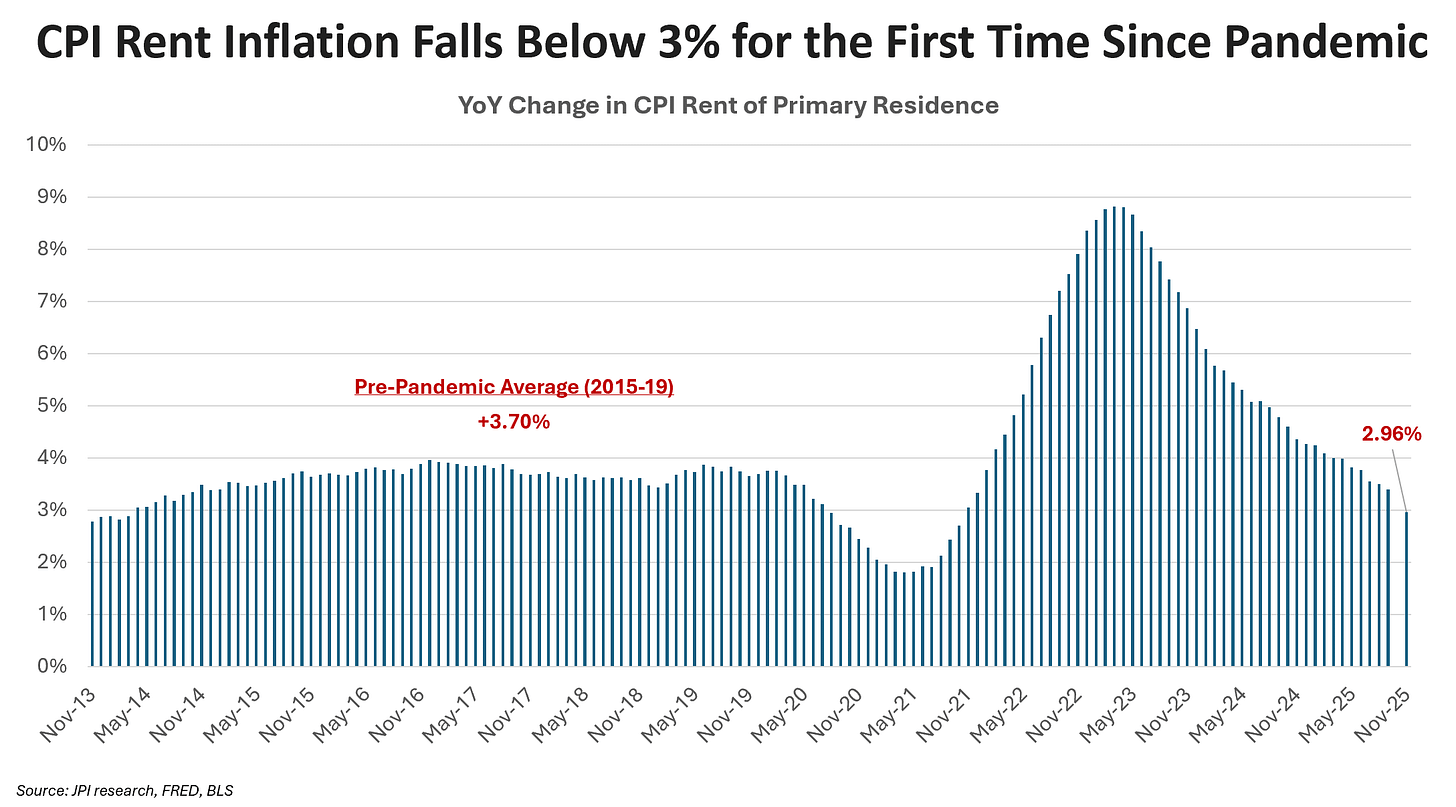
Because it’s actually even better. Much better.
And I’m sick and tired of the data from the BLS that is absolute shit.
We are absolutely not growing shelter inflation at a 3% clip. Not even close.
Why?
No, it’s not just an anecdote from my rental properties (which averaged 0-1% increases this year).
The aggregate data collected in near real-time from the private operators’ data tells a different story: rental growth is NOT happening.
Yardi Matrix November report shows national multifamily asking rents flat, around a median $1,740, up just 0.2% YoY but down MoM—the fourth straight monthly decline. Lingering deliveries + weakening jobs/consumer confidence = muted demand. But the supply pipeline is easing, so we will likely see a modest rebound in 2026 of ~1-2%.
Apartment List’s latest report on multifamily rentals shows asking rents down 1.1% YoY. The national vacancy rate remains at 7.2% this month, a record high for their index. We are “now past the peak of a multifamily construction surge, but a healthy supply of new units is still hitting the market and colliding with sluggish demand, causing vacancies to continue trending up.” They continued, “While it’s expected to see rent prices dip slightly at this time of year… Monthly rent growth peaked at +0.7% in March this year, but then began to gradually trend down during the peak moving months, when rent growth is normally fastest. The flip to negative MoM growth also came a bit earlier than what we saw in pre-pandemic years, making this the third straight year that prices have begun to dip in August.”
Zonda’s reports echo this: rents are flattening or dipping in many markets as supply catches up.
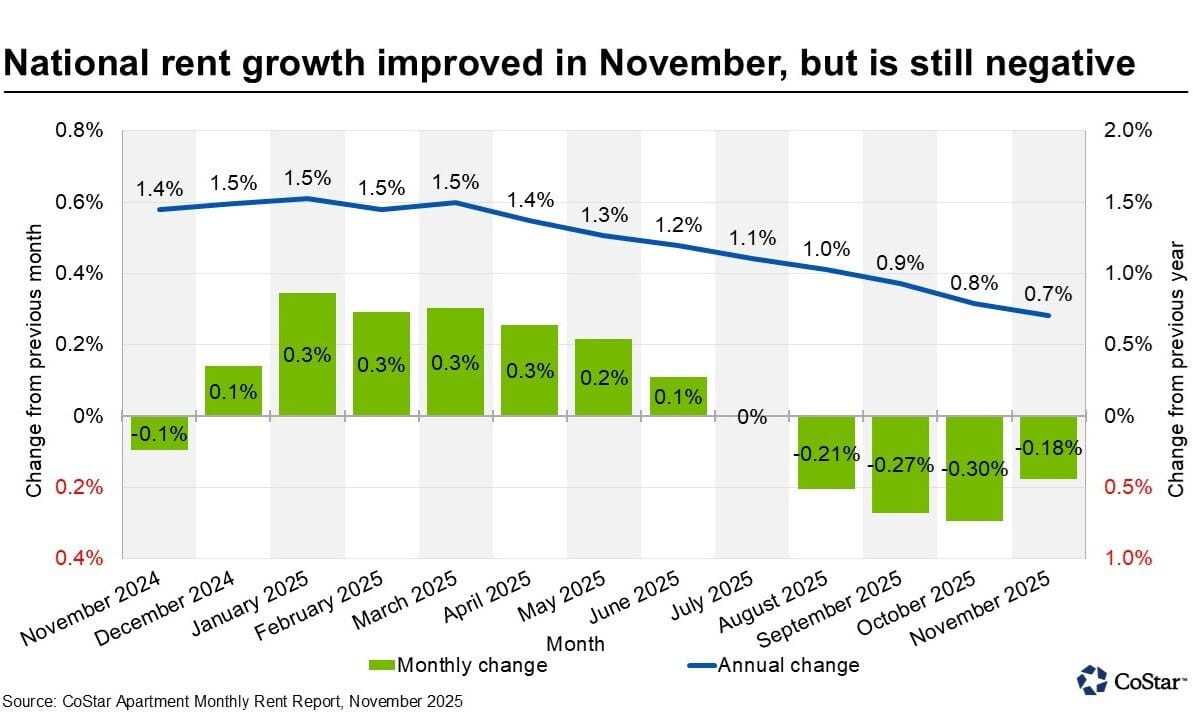
CoStar. Rents were down .7% YoY in November. This is 5 straight months of flat or declining rents, with seasonal weakness amplified by lingering new housing unit deliveries.
Zillow’s Observed Rent Index has been signaling rent deceleration since mid-2023, and for November it shows rents basically flat YoY -.2%. Zillow expects rents to stay muted through winter, with stabilization ahead as new housing unit completions drop off in 2026.
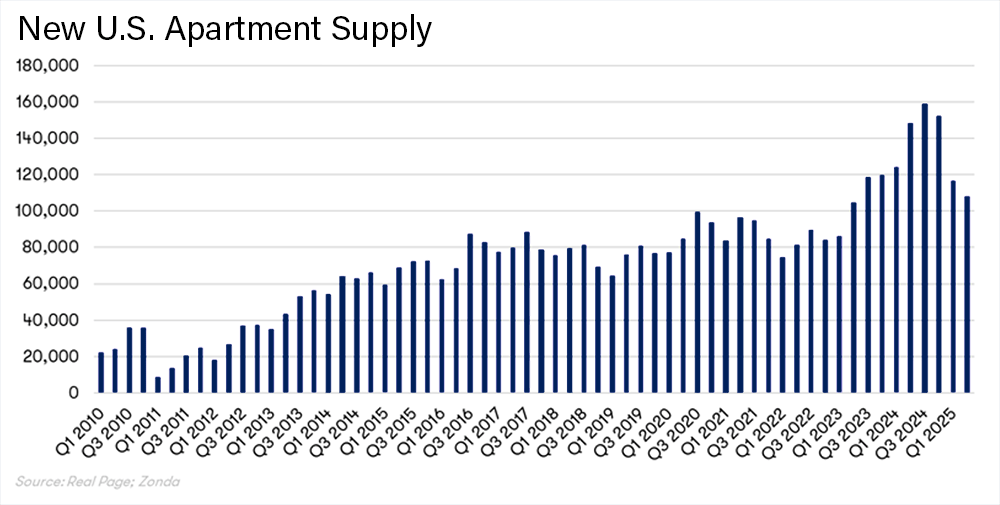
Real Page. Slowing rent growth turned slightly negative to -.7% YoY in November, with vacancy staying strong but also dipping slightly .1%. They note that after 3 months of declines, the pace of cuts held steady in November, due to lingering lease-up pressure from the 2024-2025 apartment supply peak. But, supply is slowing sharply, setting up a rebound (likely modest, ~2-3% national in 2026) as new apartment unit absorption catches up.
This supply cliff is exactly what we have been talking about the last few months. Article here.
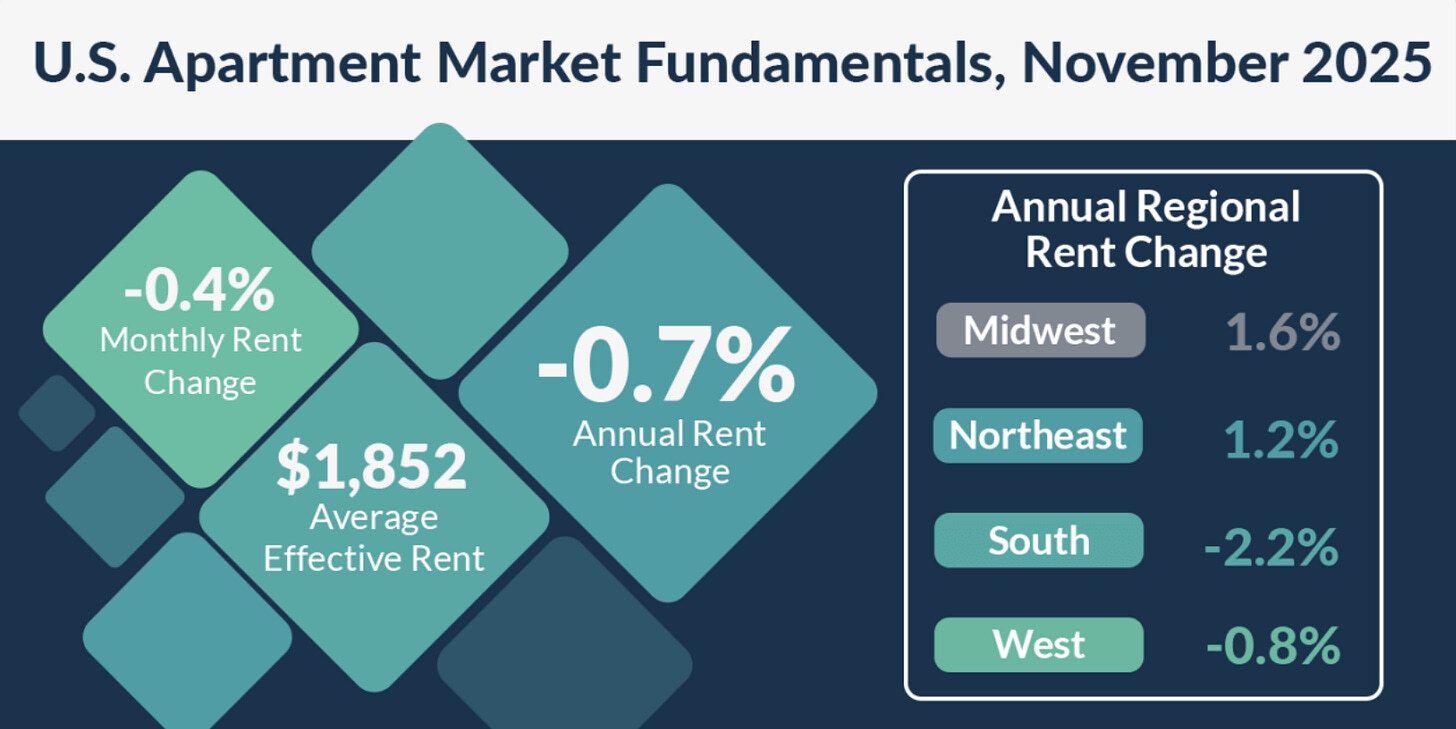
Real Page November Report
The theme seems pretty damn clear: If you build lots of housing, rents don’t inflate.
Hint hint, government leaders...
The Big Whammy: Inflation Is Likely Below 2% Today
A high shelter number throws off the entire inflation number.
Why?
Shelter makes up about 35.5% of CPI, the largest weight in the index by far.
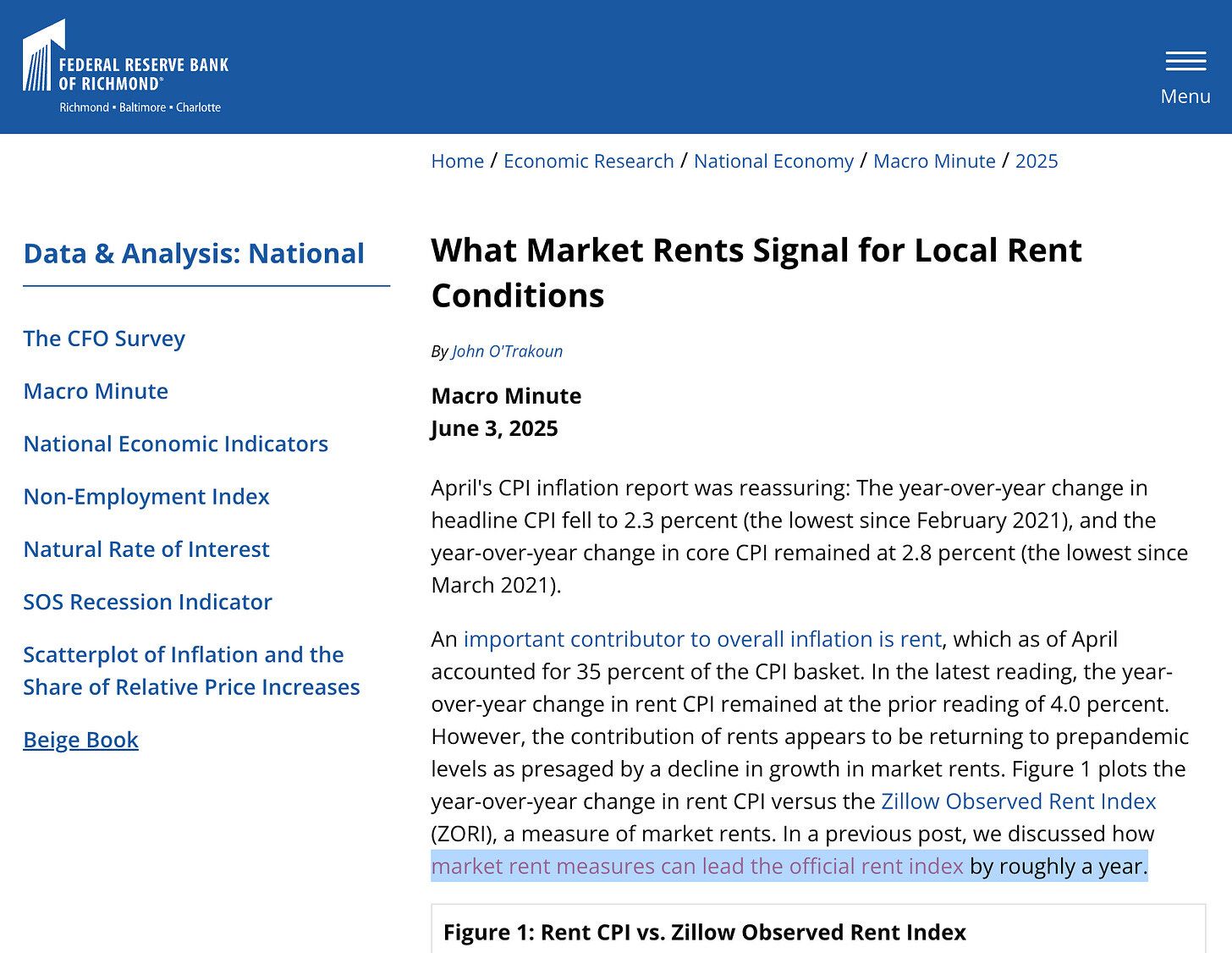
CPI shelter data lags 12+ months behind actual rents. The BLS captures continuing leases, not just new ones, so it lags market rents by 12-18 months. For example, when rents spiked in 2021-2023, CPI shelter kept climbing long after market rents cooled.
And the Fed knows shelter data is lagging.
Here is a paper the Richmond Federal Reserve put out acknowledging that shelter data lags 12+ months from private market shelter data.
So, here is some serious food for thought.
What if we dropped shelter inflation from the CPI’s 3% to match the most conservative number above, Yardi’s +0.2% YoY?
Inflation would fall to….checks notes…..
1.3%!
And if rents keep declining (as the other forecasts further moderation into 2026), shelter could go negative YoY soon, pulling headline CPI under 1%.
That’s what inflation really is today.
Wow. Just wow.
And, again, why has rent been cooling? Because we started building more apartments during the “ZERP” low-interest-rate environment of 2020-2022 than at any time in the last 50 years.
Alternative Analytics Also Has Inflation Close to 2%
Independent analytics firm Truflation has CPI at 2.17%, as of today.
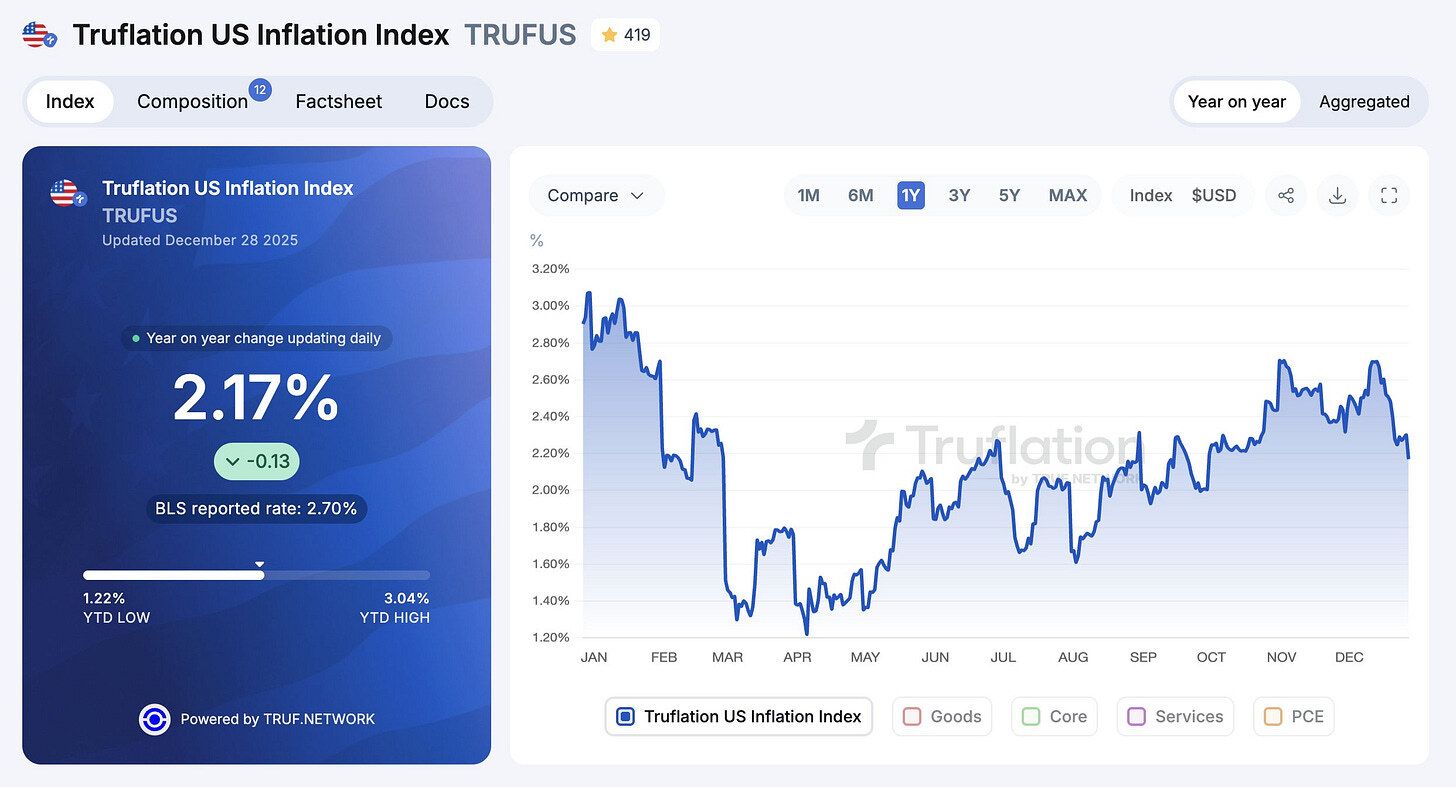
Remember. The lower inflation, the more interest rate cuts possible.
2026 could be a banner year.
The Housing Market is NOT “Frozen”
That’s right, I said it!
Transactions are still happening. We have had nearly 5,000,000 home sales in 2023, 2024, and 2025, this, despite rates at 6% - 8%. The peak in the last decade was near 6,000,000 (Mohtashami).
And every home sale contributes to the slow healing of the great mortgage rate divide, or “lock-in” as folks like to call it.
Fun fact, in 2026, more homeowners will have a rate over 6%, than below 3%.
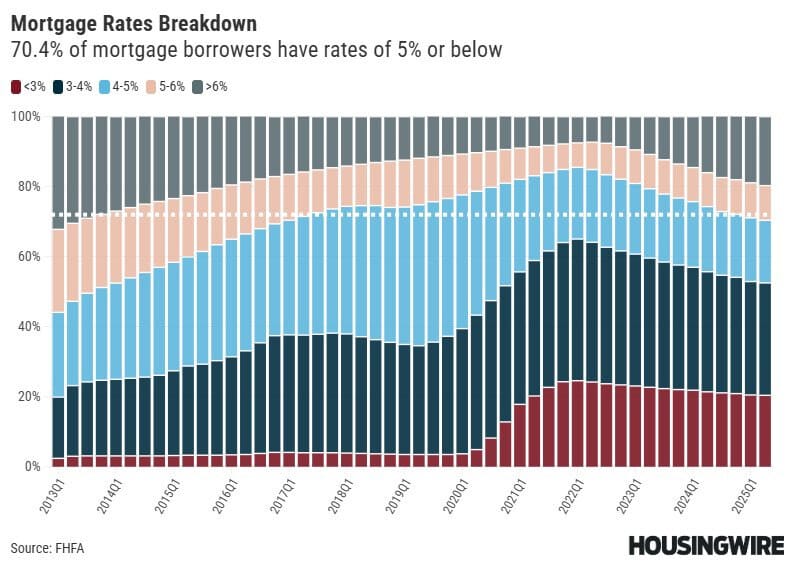
Time is all healing.
My Skeptical Take:
Affordability is driven by availability.
And Affordability is not where we want it to be.
But is it?
And has there every been a time when folks said “I love how everything is affordable!?”
No.
And today, it’s a tale of two cities.
True, Census data tells us that most people pay over 1/3 of their income on housing.
But this is highly misleading.
Why?
Because, for folks who make more than $50,000, they actually spend on average only 22% of their earnings on housing.
But for folks earning under $50,000? They spend a much higher percentage, upwards of 50% on housing.
Hell, 22% of folks who live in an apartment make under $20,000 a year! That really skews the numbers.
So, affordability is a problem, and it falls heavily on the poor.
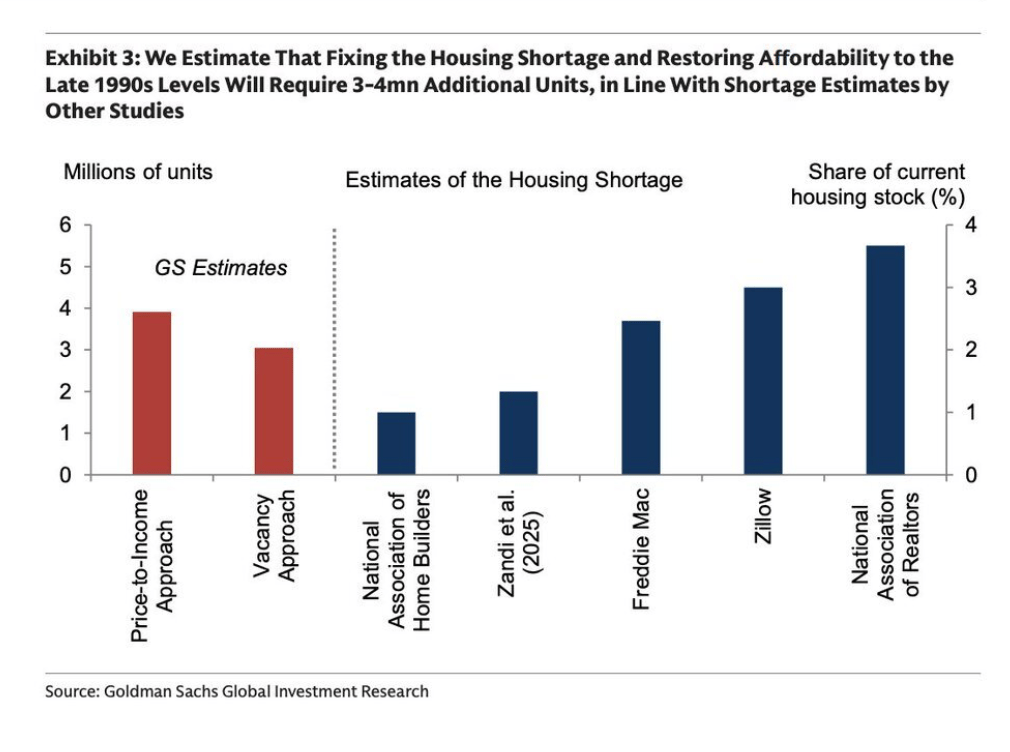
As we can see above, the only solution is to build more housing units. A lack of available homes props up prices, even despite cooling rents.
Home prices are not and will not cool like rents are.
Because, we are still short around 3 million homes.
Goldman Sachs
What are our leaders doing about it???
So far, nothing. Every year, it gets more and more difficult to build / renovate your home.
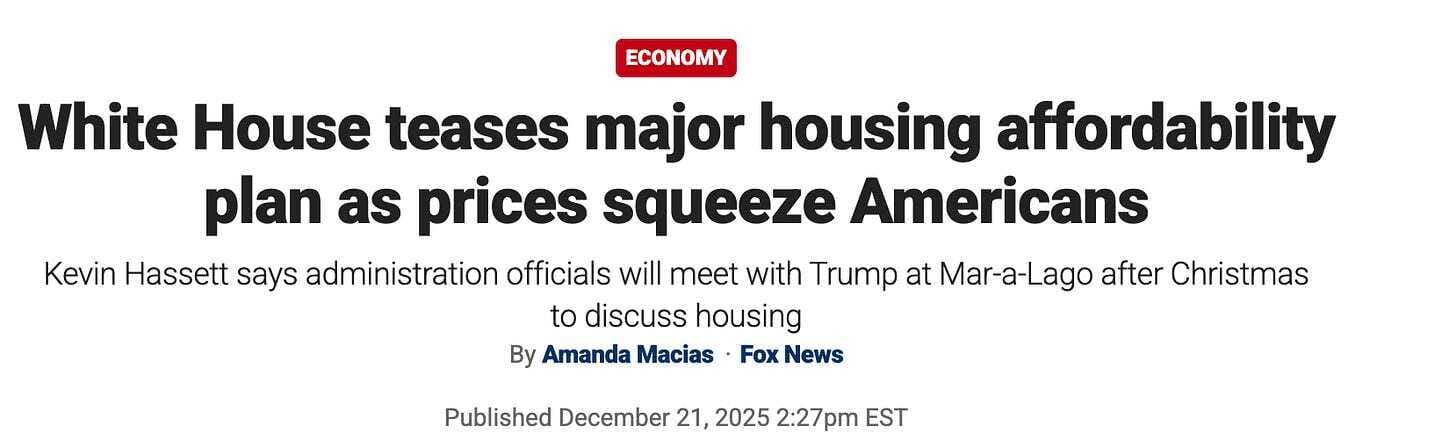
To their credit, the White House has acknowledged this issue and is reportedly planning for some housing policy changes in 2026.
Speaking on the subject, White House economic director Kevin Hassett said the other week that: “Everybody in the whole Cabinet is working on trying to get housing to be more affordable.”
And
“We have a big list of housing ideas that have been vetted very carefully by the Cabinet secretaries to present to the president in a week or two and we will see which ones he picks,” he added (FOX).”
Count me skeptical.
I’m dubious that they can make a meaningful dent.
The Federal Government would have to gather state and local governments for a total revamp of permitting and regulatory policy.
We shall see…
But unlike other issues, I think we’d ALL like to see us build baby build.
Until next time. Stay Curious. Stay Skeptical.
Herzliche Grüße,