Shutdown! The Fed is Driving Through the Fog on a Winding Road

Today’s Interest Rate: 6.17%
(👇 .14% from this time last week, 30-yr mortgage + the 30-YR FHA rate is at 5.90% today!)
This week, we’re talkin’ the economic data blackout as the government shutdown continues. I provide some helpful private sources for investors, and make a request of big business to help fix data quality.
Let’s get into it.
The Weekly 3 in News:
The Fed Pivots! Signals they may stop reducing the $6.6 trillion of assets on their balance sheet. This could mean the end of a 3+ year effort to shrink a portfolio of Treasuries that it acquired to provide stimulus after the 2020 pandemic upended the economy. I.e., stopping balance sheet shrinking = ☝️ liquidity to markets, and speeding up 👇 interest rates. (Powell).
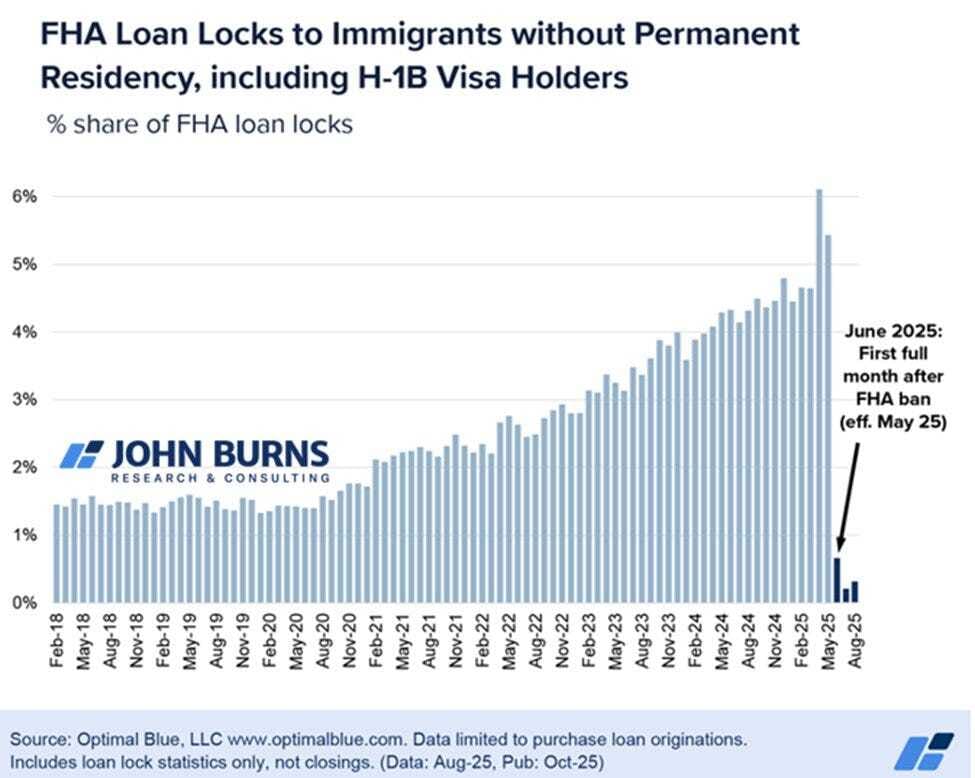
FHA (primary/entry-level) home loans to non-permanent immigrant residents have cratered. Could bring less housing demand pressure for lower-priced homes and more renter demand. WOW, that’s quite the cliff (JBREC).
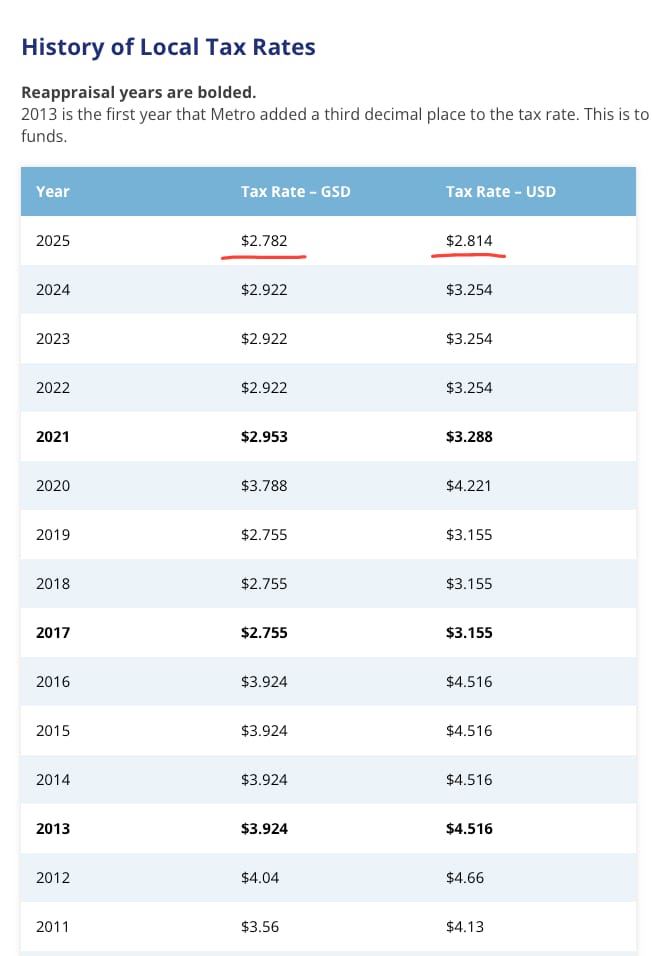
Nashville News - Nashville cut property tax rates this year to one of the lowest levels EVER! True, property values have gone up, so one’s actual tax owed may be higher this year than last year, but this tax rate cut is a really big deal. And a model for others in good governance (Property Assessor).
The Fed is Driving in the Fog
Well, another week has passed, and our congresspeople seem to be loading up their plates to continue the budgetary food fight. It has been ~3 weeks since the October 1st federal fiscal year started, and Congress appears no closer to passing its annual spending bills.
Will this have a meaningful impact on the US economy?
Mid/long term? No.
Short-term, yes. Especially if it lasts for another fortnight, and numerous federal workers, including many in the military, don’t get paid and don’t spend that money back into the economy. (Of course, one should note that in every previous Shut Down, everyone received back pay. But missing a paycheck is still no bueno).
And we investors do care because the Fed is in the ~3rd-4th inning of a Fed Rate cut cycle amidst restrictive monetary policy, which has thrown the housing/real estate sector into year 3+ of an activity recession (because of interest rates, oh, and the government borrowed and spent like drunken sailors).
Limited Inflation and Labor Market Data, So We Go Private
The Fed has a dual mandate to promote maximum employment and stable prices (aka low inflation). But the Shut Down means they do not have access to the labor and inflation data they need to make informed decisions. The people who provide that at the various agencies have been furloughed. In fact, we have missed numerous data readings since the Shut Down started, including:
Construction spending, Census Bureau
Initial good job list claims, Department of Labor
Factory Orders, Census Bureau
Non-farm payrolls, BLS
Trade balance, Bureau of Economic Research
Initial job was claims, Department of Labor
Wholesale trade, Census Bureau
Federal budget balance, Treasury Department
Consumer price index, BLS
Real average earnings, BLS
Retail sales, Census Bureau
Producer price index, BLS
Initial job was claims, Department of Labor
Business inventories, Census Bureau
Housing starts and building permits, Census Bureau
US foreign net transactions, Treasury Department
The longer this Shut Down continues, the more fog accumulates on the Fed’s front windshield.
Fed Chair Jerome Powell is well aware. Speaking last week, he said, “We’ll start to miss that data.” “[If the shutdown persists, evaluating how the economy is performing] could become more challenging.”
But, absent their traditional data streams, there are some approximations and alternate data sources we can use from the private sector. And we investors crave data!
So here are just a few I’ve pulled; there are many sources out there (and sometimes they conflict/are volatile on their own, so I recommend you aggregate).
Labor Statistics
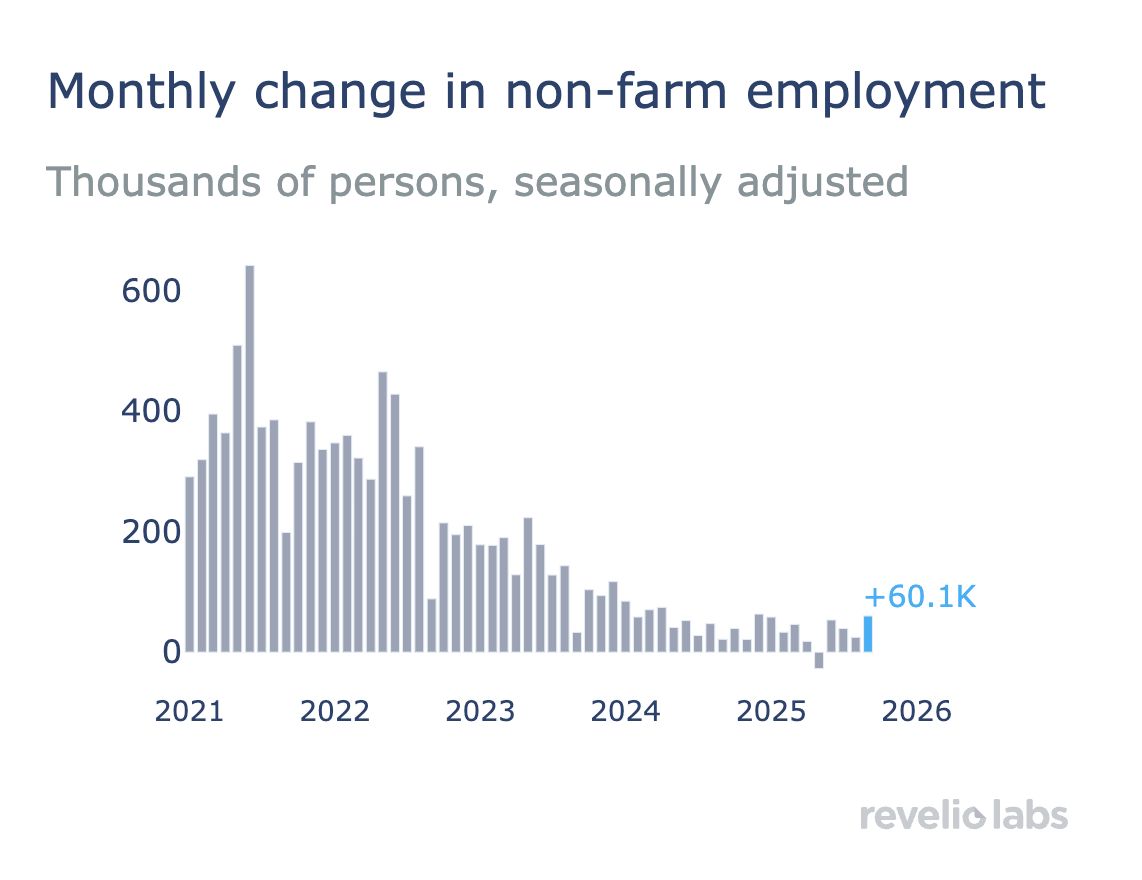
Revelio Labs - uses data from 100+ million U.S. job profiles and follows a similar format to the BLS in tracking labor data. In September, they estimate that the US economy added 60,000 jobs. This is in stark contrast to ADP below, but both still show a trending soft labor market.
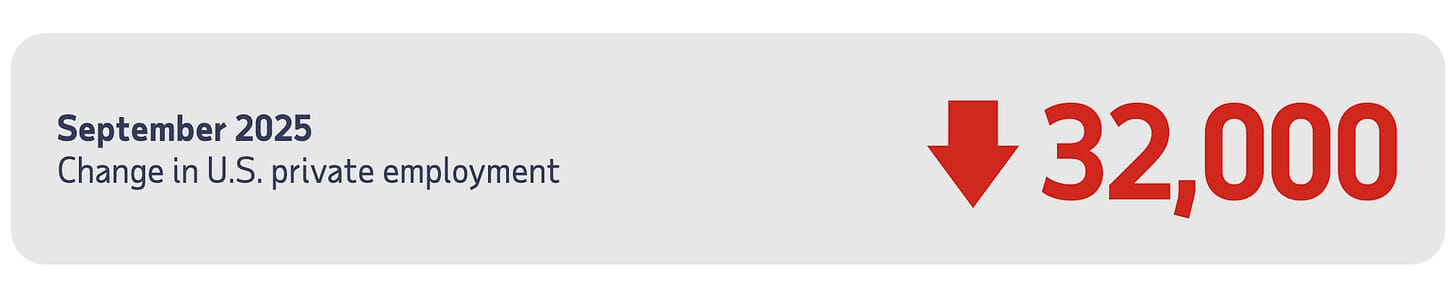
ADP - the payment processor, puts out payroll data, which we can use to extrapolate the strength of the labor sector. In September, US employment contracted by 32,000.
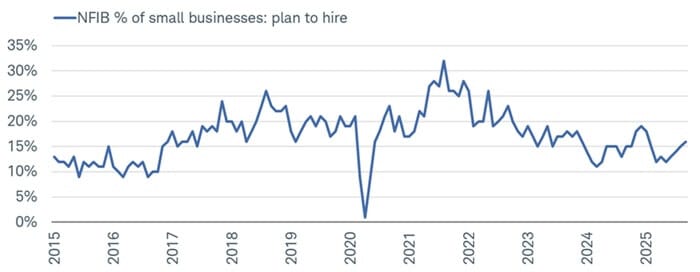
The National Federation of Independent Businesses (NFIB) - The association tracks hiring plans (a survey) from small businesses. Of note: over the past few months, hiring plans have picked up (albeit from a low base).
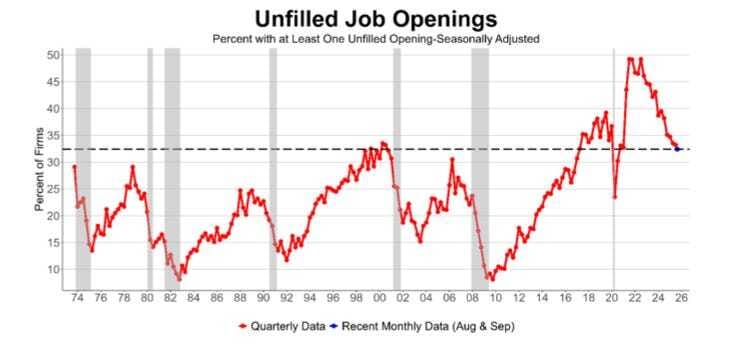
They also track job applicant quality, compensation plans and job openings, the ladder showing levels that are still above the historical average. In all, 32% of businesses reported job openings they could not fill.
My Skeptical Take:
We need a new system.
The Fed has the most meaningful impact of any government entity with their hand on the wheel of the world’s largest economy. They are running on inflation and labor market data that is based on surveys, with the latter being revised three times and by 1 million jobs in just the last year. And now even this data is suspended as Congress spits vitriol at each other, with no agreement in sight.
There has to be a better way.
I’ve lamented about the BLS labor and inflation data in the past. And regardless of the shutdown, frankly, we all should admit that it just sucks. Just the other week, Fed Governor Goolsbee admitted as much on CNBC, saying, “We’re going to get bigger revisions because people do not like answering surveys (CNBC).”
And continued by saying they have started creating their own measure of economic data, “We’ve recently rolled out the Chicago Fed Labor Market Indicators…we turn to 11 different data sources. We take the official data plus high-quality private sector sources…[to make] a real-time estimate of what will be the unemployment rate.”
According to their model, the unemployment rate that would have been announced if the BLS were not shut down would have been 4.3%. Unchanged from the September BLS number.
So even the Fed knows the data could be better.
So I ask…
@Amazon, Google, Home Depot, Walmart, Exxon, etc… why don’t you aggregate and provide inflation data publicly (via a non-profit/independent data entity) and/or to federal agencies to fix this gap we have in inflation (and perhaps labor) data? This seems like an area where the private sector can fix this, and could do so quite quickly.
What say you?
I hope you say, “Oh yeah, makes sense. On it.”
Until next time. Stay Curious. Stay Skeptical.
-The Skeptical Investor