Scary Movie 7: Middle East Oil Markets

Today’s Interest Rate: 6.53%
(☝️.12% from this time last week, 30-yr mortgage)
This week, we’re talkin’ how the global oil panic may be ending, labor markets and what to expect in the next few weeks.
Let’s get into it.
The Weekly 3 in News:
US companies are leading the way in new computer chip fabrication, robotics, and AI… in outer space! SpaceX / Tesla / Xai announced the TERAFAB. Star Trek is becoming real, just wow. (SpaceX).
Feel Good News - William Shatner is 95! And he celebrated by smoking a cigar. “Never trust anyone who says you should ‘act your age.’” I just love this (WilliamShatner).
TN News — Tennessee was the #5 state in IRS tax revenue gained, coming in at +$2.7B, according to the IRS (2023 data just came out). The top 10 state gainers were: FL $+20.6B, TX $+5.3B, SC $+4.1B, NC $+3.9B, TN $+2.7B, AZ $+2.7B, NV $+1.5B, ID $+981M, NH $+743M, GA $+678M (IRS, Smirkley).
Hello, fellow real estate investors, and those who are at least investor-curious.
It’s another week, and yes, I’m going to talk about the Middle East conflict again.
I know, I know…Why?
Well, unfortunately, it matters, especially for us. The conflict affects the price of oil and interest rates, which, like gravity, affect everything.
But, this could be the last week this show is on prime time, and we can move on to other, less gruesome issues.
Scary Movie 7: Middle East Oil Markets
Last week I wrote that the “global oil panic may be over.”
Well, it’s 6 days later and markets are still in scary movie mode.
But I still do not see the conflict continuing much longer. And if most hostilities end in March, we shouldn’t have any lasting inflation
So, I’m doubling down on detant.
The driving factor for this was yesterday, when 22 Arab and European countries joined together in solidarity, condemning Iranian aggression and global (oil) trade disruption, saying:
The group issued a strongly worded joint statement condemning “in the strongest terms” Iran’s recent attacks on unarmed commercial vessels, strikes on civilian oil and gas infrastructure, and what it described as the de facto closure of the strait by Iranian forces through mines, drones, and missiles.
“We condemn in the strongest terms recent attacks by Iran on unarmed commercial vessels in the Gulf, attacks on civilian infrastructure including oil and gas installations, and the de facto closure of the Strait of Hormuz by Iranian forces,” said the 22 countries, mostly European but also including the UAE and Bahrain.
NATO Secretary General Mark Rutte added his supporting comments, “we're coming together to make sure that we can be able to secure the Strait of Hormuz."
Saudi’s getting more involved.
At the same time, Saudi Arabia on Saturday declared Iran’s military attaché in Riyadh, his deputy, and three other embassy staff persona non grata, ordering them to leave, over what it called Tehran’s “flagrant” attacks on the kingdom, Gulf states and other Arab and Muslim countries.
Saudi’s foreign minister then upped the ante, saying continued Iranian strikes would violate Saudi sovereignty, vowing to take all necessary measures to protect its territory and people.
The catalyst for these actions may also have been Iran brandishing its long-range ballistic missile capabilities, launching 2 missiles at the joint UK/US base Diego Garcia, which is ~2,350 miles away. The US and Israel may step up efforts after witnessing this, which could prolong the conflict. Tehran is 1100 miles from Jerusalem.
Remember, the Strait of Hormuz is not just another waterway—it is the single most critical chokepoint in global energy trade. Roughly one-fifth of the world’s oil supply (around 20 million barrels per day) and a substantial share of liquefied natural gas pass through its narrow channel every day. For decades, Iran has wielded the threat of blocking or harassing traffic here as a strategic trump card in its confrontations with Israel, the United States, and the West. Yet the composition of this coalition changes the game. The active participation of Gulf Arab states like the UAE and Bahrain—countries that have pursued economic normalization and stability rather than confrontation—signals that even Iran’s regional neighbors have reached a breaking point.
Well, and then, the US said hold my beer…
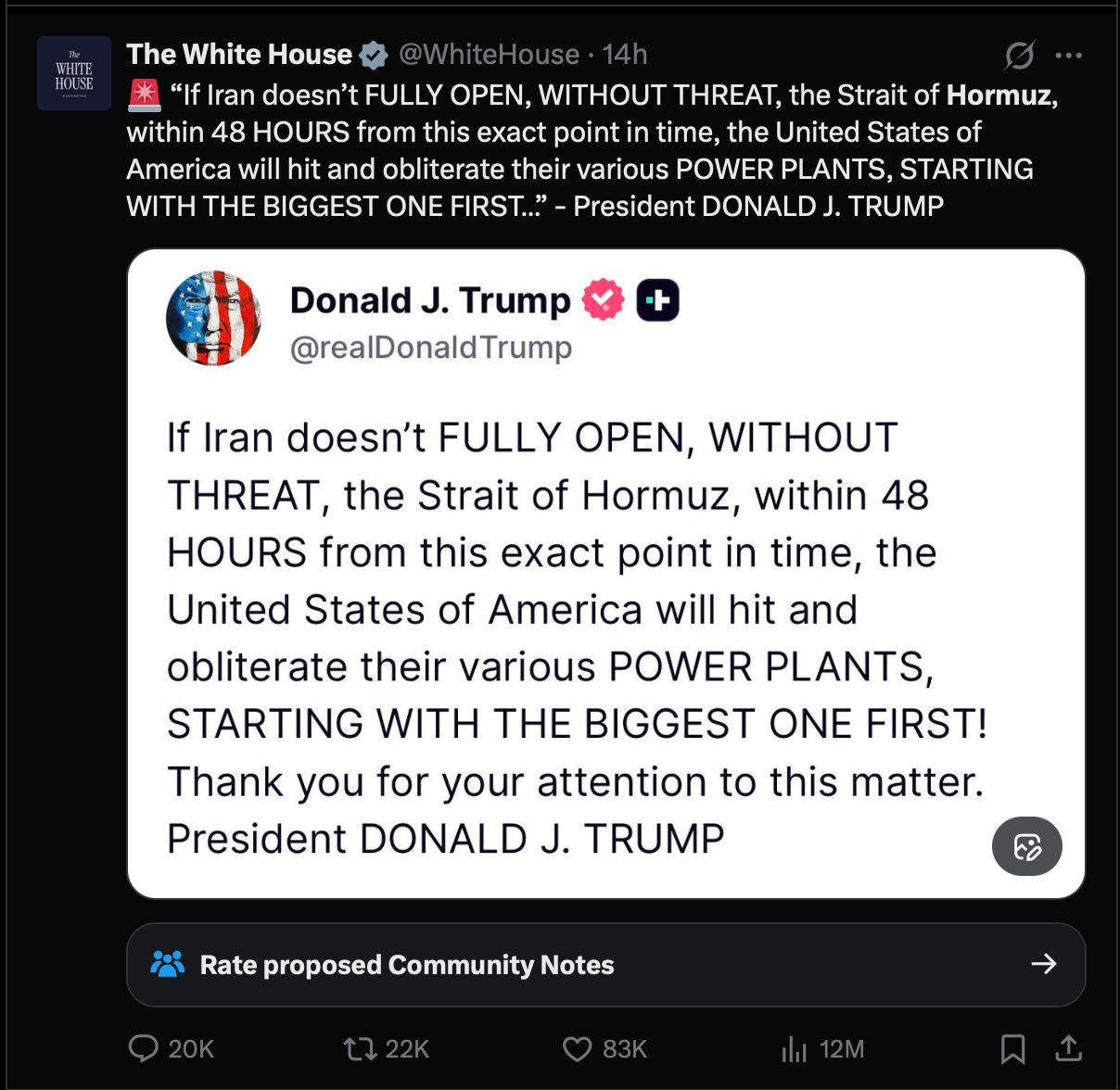
32 hours left….Oh boy…
Silver Lining: Iran’s “Tax” On Gas Prices May Finally Be Over
There is one positive that may come out of this conflict. Iran’s tax on global gas prices may finally be over.
And I don’t want to come across as blase about this conflict, but this is after all an investor newsletter, so please read these words with that context in mind.
So what do I mean exactly?
Iran’s longstanding threat to disrupt the Strait of Hormuz, and military harassment in the region has imposed a persistent “tax” on world oil prices, long before the current conflict escalated into active disruptions.
Energy analysts and market reports frequently describe this as a geopolitical risk premium embedded in crude pricing. Traders and investors price in the probability of Iranian harassment, mining, attacks on tankers, or partial/full closure, which adds a forward-looking buffer to oil futures. Estimates of this premium have varied over time but often range from $5–$15 per barrel (or more during heightened tensions):
Goldman Sachs and similar analyses have pegged it around $10–$14 in recent pre-escalation periods, reflecting compensation for potential supply shocks (GS/Bloomberg).
Oxford Economics cited about $9 amid 2026 tensions.
Broader commentary (e.g., from analysts like Daniel Yergin) has framed it as a $10 geopolitical layer that quietly elevates baseline prices (Barrons).
This premium manifests through:
Elevated war-risk insurance premiums for tankers (which spike during threats and pass costs to oil buyers).
Higher freight rates and precautionary stockpiling.
Market psychology and risk analysis. Even low-probability risks deter full normalization of value and inflate prices.
Before this escalation, when threats turned into effective disruptions and closures, this acted as an ongoing drag on market efficiency—preventing oil from falling as low as fundamentals alone might have allowed.
Moving Forward: What’s Next?
I do (still) believe, contrary to most analysts, that the US Administration will soon take the ‘win,’ having halted nuclear and ballistic missile production and decimated the military capabilities of Iran (see my article 2 week’s ago). Iran has been behind pretty much all ‘mischief’ throughout the Middle East for decades and most of the world wants to see it stop.
What is “soon?” Less than 1 month, likely less than 2 weeks.
After that point, the US will step back into a supporting role and focus on aiding regional allies to resume the global oil trade. I also anticipate infrastructure funding/support for new east-west pipelines from the Persian Gulf coast, across Saudi Arabia, to the Red Sea. China and India, in particular, would support this.
Without it, the risk premium on oil prices will persist in perpetuity.
My Skeptical Take:
If my skeptical take on the consensus is correct, inflation projections/worries should plummet this and next week.
Ships in the Straight will start moving, and market fear will ebb, rapidly bringing down inflation projections. This will bring a sharp positive correction up in treasuries, dropping interest rates on the 10-yr Treasury and, thus, mortgage, credit card and other short-term interest rates.
Good for US real estate investment. (Whew, I know that was a long thread to pull).
The Fed will now be given market permission to refocus on the softening labor market here at home.
Finally.
This is the real elephant in the room, not what is happening in the Middle East.
Labor > Inflation.
The Federal Reserve needs to get its head in the game. Recent labor data points to a labor market that’s cooling:
February’s unexpected job losses.
The unemployment rate is ticking up to 4.4%.
Persistently low levels of folks quitting their jobs (JOLTS report).
Small business hiring plans are pulling back.
Small Business employment indices are tightening.
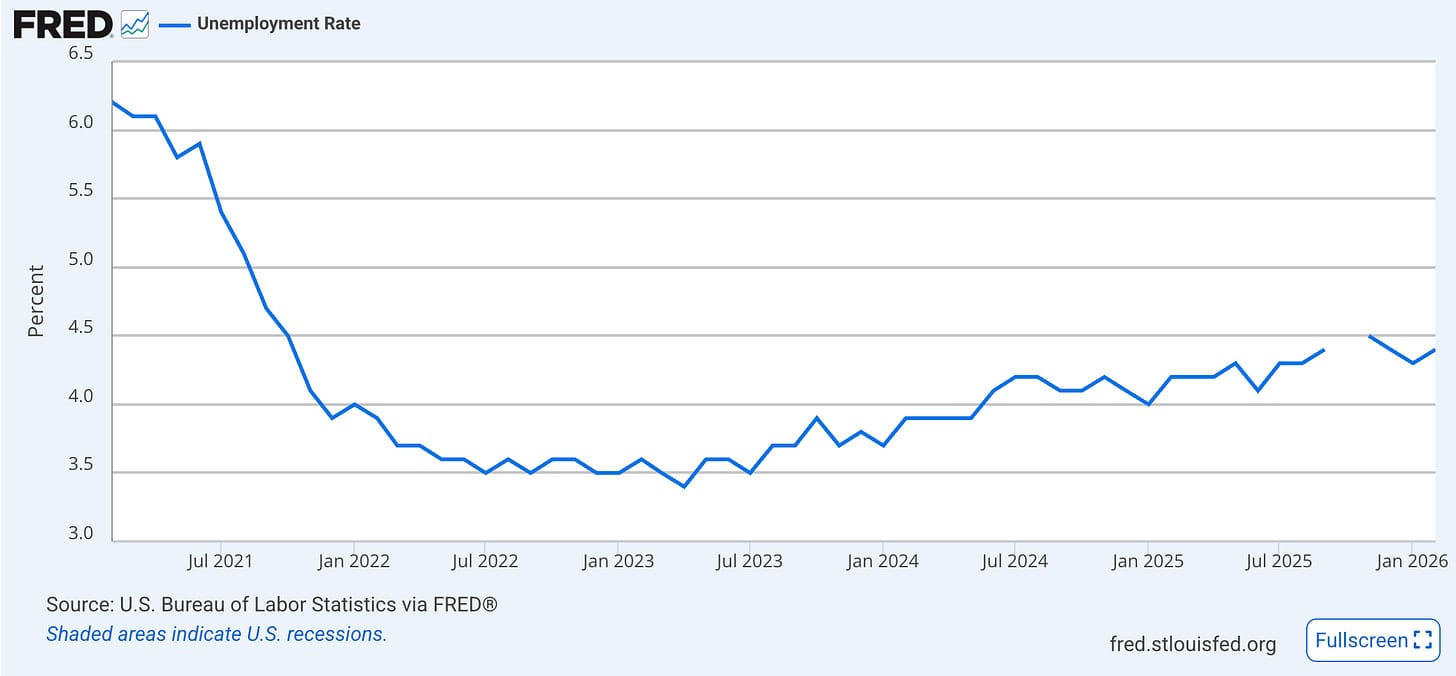
The direction is negative, demand for workers is weaker.
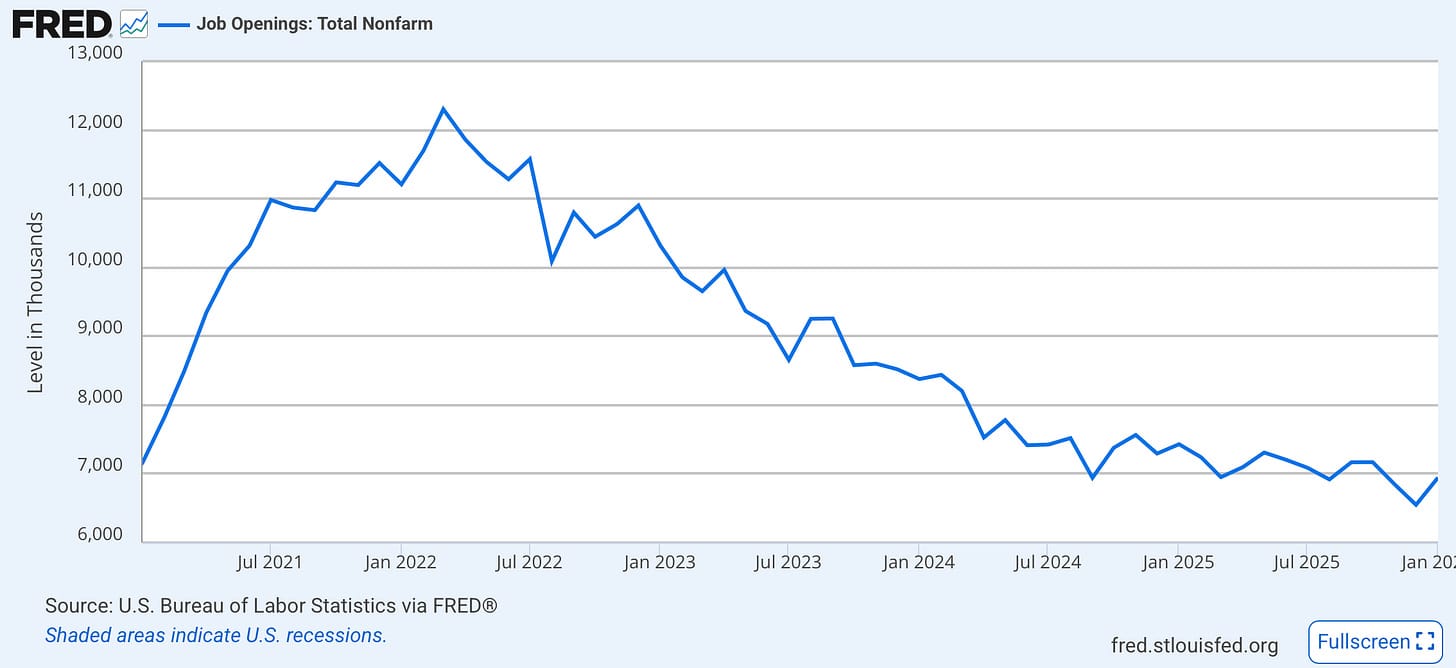
If the Fed is to cut rates further, its attention must pivot from inflation worries to labor worries; otherwise, inflation fears will derail interest rate normalization. That’s the setup we investors have been waiting for.
And this is why the Iran conflict has been top of mind for me these last few weeks.
The Fed has a tough job ahead.
Until next time. Stay Curious. Stay Skeptical.
Herzliche Grüße,